Walking Pad Storage Tips: How to Store and Fold (2026)
Current product-safety notice: CPSC warned consumers on April 16, 2026 to stop using specified Sperax Pro, Q1, RM-01 and RM-02 walking pads and treadmills. We removed older recommendations and shopping links for that brand while exact models are re-audited. Check the official CPSC warning and follow its stop-use instructions.
A walking pad that is hard to get out is a walking pad that does not get used. This is the single most important storage principle: convenience drives usage. Store it where setup takes seconds, not minutes. Every extra step between "I should walk" and actually walking is a reason your brain will choose to sit instead.
The second principle: protect the pad. Walking pads are electronics with moving parts — belts dry out, motors collect dust, displays crack if dropped. Proper storage preserves the equipment. Improper storage shortens its lifespan.
This guide covers every storage method — from the 5-second under-desk slide to full long-term preparation for months of non-use.
Foldable vs Flat: Storage Differences
Foldable Walking Pads
Foldable pads have a center hinge that allows the pad to fold in half, with the walking belt on the inside. When folded, they are approximately half the length and double the height.
| Dimension | Unfolded | Folded |
|---|---|---|
| Length | 50–58" | 25–30" |
| Width | 20–24" | 20–24" (same) |
| Height | 4.5–5.5" | 9–11" |
| Floor footprint | ~8–10 sq ft | ~3.5–5 sq ft |
Storage advantages: Can stand upright against a wall. Fits in closets. Takes half the floor space when stored.
Storage disadvantages: Heavier to lift and fold. Hinge mechanism adds a failure point. Thicker when folded (may not fit under low furniture).
Flat (Non-Foldable) Walking Pads
Flat pads are a single rigid piece with no hinge. They are thin and designed to slide under furniture.
| Dimension | Value |
|---|---|
| Length | 50–58" |
| Width | 20–27" |
| Height | 4.0–5.0" |
| Floor footprint | ~8–11 sq ft |
Storage advantages: Slide under desks, beds, and couches. Thinner profile fits under lower furniture. No hinge to wear out.
Storage disadvantages: Cannot fold — takes full footprint if not under furniture. Cannot stand upright (too long and heavy). Must have furniture with clearance.
Quick Comparison
| Storage Method | Foldable | Flat |
|---|---|---|
| Upright against wall | ✅ Best option | ❌ Not possible |
| Under desk | ⚠️ Only if thin enough unfolded | ✅ Best option |
| Under bed | ⚠️ Only if bed has 10"+ clearance (folded) | ✅ Fits under most beds (5"+ clearance) |
| In closet | ✅ Folds to fit | ⚠️ Requires deep closet |
| Behind furniture | ✅ Folds compact | ❌ Too long for most gaps |
How to Fold a Walking Pad (Step by Step)
Before Folding
| Step | Action | Why |
|---|---|---|
| 1 | Stop the belt completely | Never fold while the belt is moving |
| 2 | Turn off the power switch | Prevents accidental activation during folding |
| 3 | Unplug the power cord | Cord should not be attached during folding — it catches and tangles |
| 4 | Coil the cord loosely | Secure with a velcro tie; set beside or on top of the pad |
Folding Steps
| Step | Action | Details |
|---|---|---|
| 1 | Stand at the lighter end | The lighter end (usually rear, away from the motor/display) lifts first |
| 2 | Grip the rear edge | Both hands, shoulder-width apart |
| 3 | Lift upward | Raise the rear end toward the front end; the center hinge engages |
| 4 | Guide to closed position | The two halves come together; belt surfaces face inward (protected) |
| 5 | Engage the lock | Clasp, strap, magnetic lock, or kick-stand — depends on model |
| 6 | Test stability | Gently release — the pad should hold its folded position securely |
Model-Specific Folding Notes
| Model | Hinge Type | Lock Type | Folding Effort |
|---|---|---|---|
| WalkingPad C2 Mini | Center hinge | Magnetic lock | Light — 33 lbs total |
| WalkingPad R2 | Center hinge | Magnetic lock | Light — 33 lbs total |
| Goplus 2-in-1 | Handlebar folds (not pad) | Handlebar clasp | Moderate — handlebar only |
| REDLIRO | Center hinge | Strap lock | Moderate — 42 lbs total |
Note: The Goplus 2-in-1 folds the handlebar down — the walking pad itself does not fold. This is important: the pad still takes its full-length footprint when stored. The "foldable" claim refers to the handlebar.
Best Storage Locations (Ranked by Convenience)
Ranking: Setup Time to Walking
| Rank | Location | Setup Time | Effort | Best For |
|---|---|---|---|---|
| 1 | Under your desk (flat pad) | 5 seconds | Slide out | Daily desk walkers |
| 2 | Against the wall beside desk (folded) | 10 seconds | Unfold, place | Daily users, foldable pads |
| 3 | Under bed or couch (flat pad) | 15 seconds | Slide out, carry to desk | Daily users with limited desk space |
| 4 | Same-room closet (folded) | 30 seconds | Open closet, unfold, place | Occasional users |
| 5 | Different-room closet | 1–2 minutes | Walk to closet, carry, unfold, place | Infrequent users |
| 6 | Garage or basement | 2–5 minutes | Retrieve, carry upstairs, set up | Rarely used (not recommended) |
The 15-Second Rule
If it takes more than 15 seconds to get your walking pad from storage to operational, you will use it less. This is not about discipline — it is about friction. Every second of setup time gives your brain another reason to skip today's walk. The people who use their walking pads daily are the ones who stored them within arm's reach of their desk.
Under-Desk Storage
The Ideal Setup
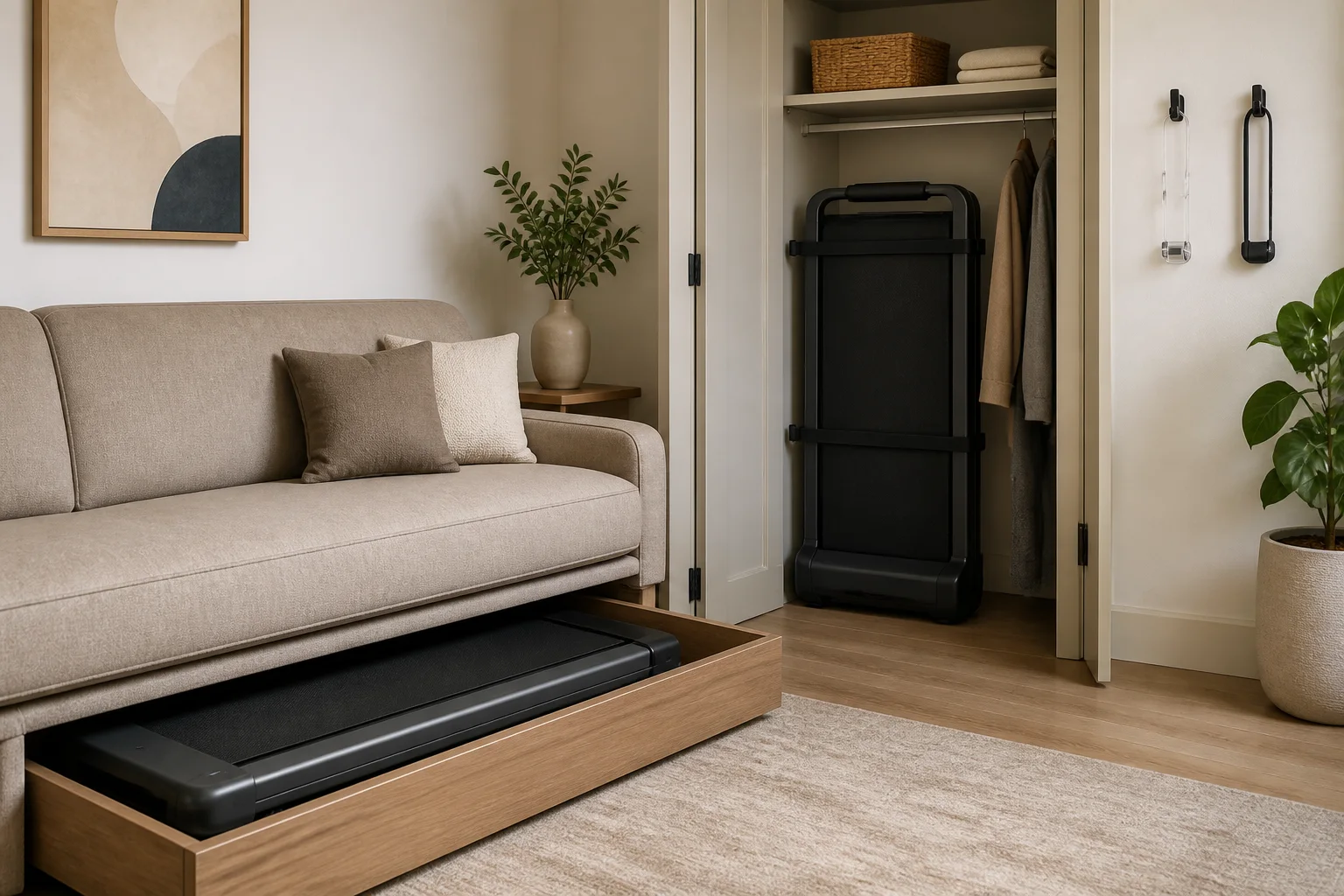
Under-desk storage works for flat (non-foldable) walking pads. The pad slides under the desk when not in use and slides out to its walking position when needed. This is the fastest storage-to-use transition.
Requirements
| Requirement | Minimum | Ideal |
|---|---|---|
| Desk clearance (height) | Pad height + 0.5" (4.5–5.5") | Pad height + 2" (6–7") |
| Desk depth | Pad length (50–58") | Pad length + 6" |
| Floor surface | Hard floor or thin mat | Hard floor with furniture sliders under pad |
How to Slide Easily
| Tip | Method |
|---|---|
| Furniture sliders | Stick adhesive furniture sliders (felt or PTFE) to the bottom corners of the pad — glides on hard floors |
| Thin mat | Place the pad on a thin mat; slide the mat (with pad on it) as a unit |
| Orientation | Store the pad so the motor end (heavier) is at the back and the lighter end faces you — easier to pull out |
| Power cord routing | Route the cord along the desk leg so it stays connected even when stored — no plugging/unplugging each use |
Cord Management for Under-Desk Storage
| Approach | Pros | Cons |
|---|---|---|
| Leave plugged in, cord along desk leg | Zero setup — slide out and walk | Cord is always visible; tripping risk if poorly routed |
| Unplug and coil on top of pad | Clean look; safe | 10 seconds added to each use for plugging in |
| Retractable cord reel mounted to desk | Clean, fast, always accessible | Requires installation; $10–15 |
For complete under-desk setup guidance, see our walking pad under standing desk guide.
Against-the-Wall Storage
For Foldable Walking Pads
Folded walking pads stand upright against a wall in a compact footprint. This is the most space-efficient storage method.
Setup
| Step | Action |
|---|---|
| 1 | Fold the pad (see folding steps above) |
| 2 | Stand the folded pad on the hinge end (bottom) |
| 3 | Lean it against the wall with the flat side touching the wall |
| 4 | Position in a corner for maximum stability (two walls for support) |
| 5 | Coil the cord and hang it on the pad or tuck behind it |
Footprint
| Model | Folded Footprint (Against Wall) |
|---|---|
| WalkingPad C2 Mini | ~25" × 21" (3.6 sq ft) |
| WalkingPad R2 | ~29" × 24" (4.8 sq ft) |
| REDLIRO | ~28" × 23" (4.5 sq ft) |
Safety Consideration
A folded walking pad standing against a wall can tip if bumped. In homes with young children or pets:
- Store in a corner (two-wall support)
- Consider a wall-mounted hook or strap at the top to prevent tipping
- Do not store in high-traffic hallways where it might be bumped
Under-Bed and Under-Couch Storage
Clearance Requirements
| Furniture | Typical Clearance | Fits Flat Pad? | Fits Folded Pad? |
|---|---|---|---|
| Standard bed frame | 6–8" | ✅ Yes | ❌ Too thick |
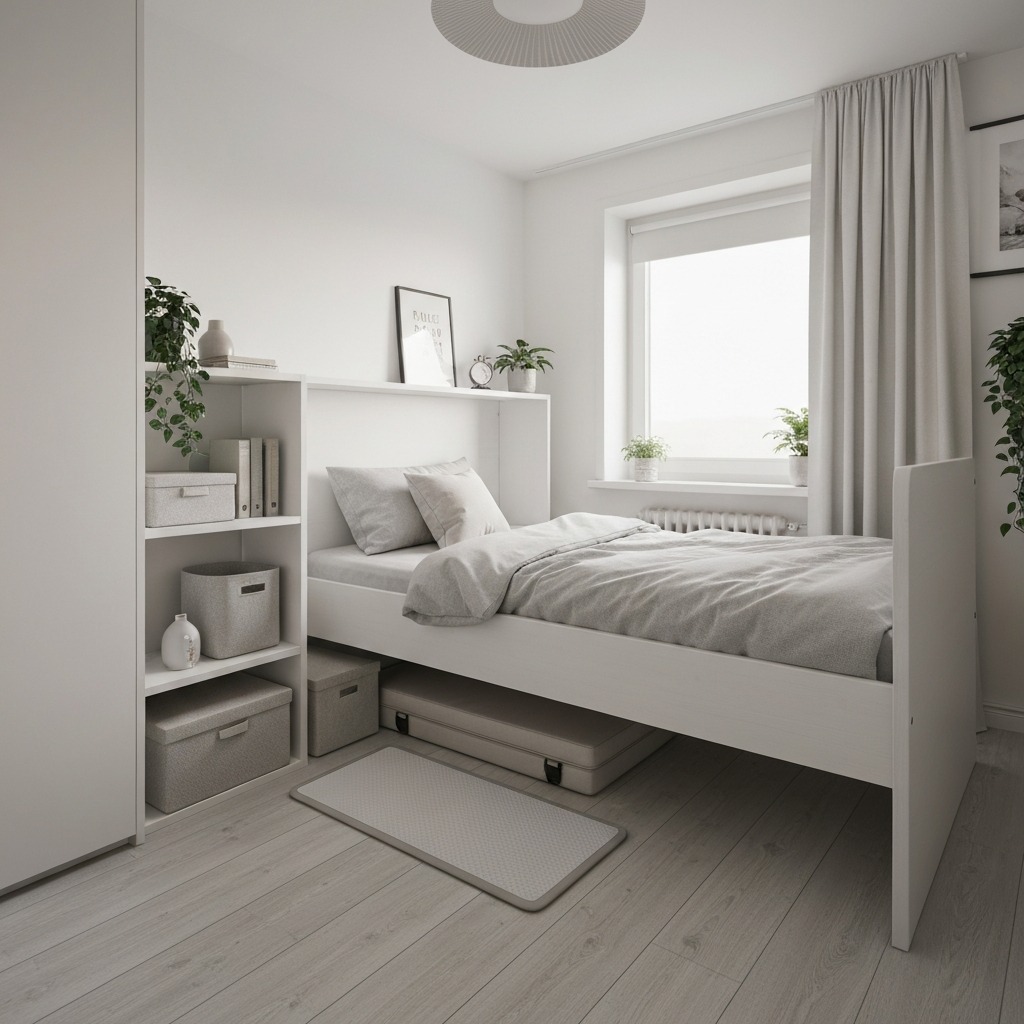
| Platform bed | 3–5" | ⚠️ Only thinnest pads (~4") | ❌ No |
| Bed on risers | 8–12" | ✅ Yes | ⚠️ Maybe (if 10"+) |
| Standard couch | 3–5" | ⚠️ Only thinnest pads | ❌ No |
| Couch on legs | 5–8" | ✅ Yes | ❌ Usually too thick |
Making Under-Bed Storage Work
| Tip | Benefit |
|---|---|
| Bed risers | Add 3–6" of clearance for $15–25; creates ample room for any walking pad |
| Furniture sliders on pad | Allows smooth slide in/out without scratching the floor |
| Store motor-end toward headboard | Pull from the lighter (foot) end — easier to extract |
| Dedicated "pad side" | Always store on the same side of the bed for consistent retrieval |
| Thin dust cover | A fitted sheet or thin fabric prevents under-bed dust from accumulating on the belt |
Under-Couch Storage
Under-couch storage works for the thinnest flat pads (4.0–4.5" height) under couches with legs. The pad extends beyond the couch (they are 50–58" long; couches are typically 34–40" deep), so the rear portion will be visible behind the couch.
Closet and Out-of-Sight Storage
When Closet Storage Makes Sense
- You do not use the walking pad daily
- You have limited floor space in your workspace
- You prefer a clean, equipment-free room aesthetic
- The walking pad is a shared household item (used by different people in different rooms)
Closet Storage Setup
| Step | Action | Notes |
|---|---|---|
| 1 | Fold the pad (foldable models) | Flat pads need a deep closet (50–58" internal depth) |
| 2 | Stand upright in the closet | Lean against the closet wall; position in a corner |
| 3 | Coil the cord | Secure with velcro tie; hang on the pad or place in a bag on the shelf above |
| 4 | Store the remote | Tape the remote to the pad or put it in a labeled bag on the shelf |
| 5 | Leave the closet door accessible | Do not pile items in front — friction kills usage |
The Convenience Problem
Closet storage adds 30–60 seconds to each use: open closet, extract pad, carry to desk, unfold, plug in, set up remote. This sounds trivial but it is enough friction to reduce usage. Most people who store walking pads in closets use them 2–3 times per week instead of daily.
If you store in a closet, commit to a routine: "Every morning before I sit down, I get the walking pad out." Making it a non-negotiable first-thing habit counteracts the friction.
Long-Term Storage Preparation
When Long-Term Storage Applies
- Moving and the walking pad will be packed for weeks
- Seasonal non-use (summer outdoor walking replaces the pad)
- Injury or medical reason prevents use for an extended period
- Renovating the room where the pad is used
Pre-Storage Checklist
| Step | Action | Why |
|---|---|---|
| 1 | Clean the belt | Wipe the belt surface with a damp cloth; remove dust, sweat, and debris |
| 2 | Lubricate the belt | Apply silicone-based treadmill belt lubricant per manufacturer instructions |
| 3 | Clean the motor vents | Blow compressed air across the motor ventilation openings to remove dust |
| 4 | Wipe the display | Clean with a dry microfiber cloth |
| 5 | Unplug and coil the cord | Loose coil — never tight; secure with velcro tie |
| 6 | Store the remote | Labeled bag taped to the pad or stored with the cord |
| 7 | Cover with breathable fabric | Sheet, towel, or dust cover — not plastic (traps moisture) |
| 8 | Choose a dry, stable location | Avoid garages, attics, basements — temperature swings and humidity damage electronics and belt material |
Storage Environment Requirements
| Factor | Acceptable | Avoid |
|---|---|---|
| Temperature | 50–85°F (10–30°C) | Below freezing; above 100°F |
| Humidity | 30–60% relative | Above 70% (moisture damage) |
| Sunlight | Indirect or none | Direct sunlight (degrades belt and plastic) |
| Dust | Covered with fabric | Open storage in dusty environments |
| Floor surface | Dry, level floor | Damp concrete (garage floor); carpet that traps moisture |
Periodic Maintenance During Long-Term Storage
| Frequency | Action | Why |
|---|---|---|
| Every 4–6 weeks | Run the pad for 5 minutes at low speed | Keeps the belt supple; redistributes lubricant; exercises the motor |
| Every 2–3 months | Inspect for dust, moisture, or pest intrusion | Early catch prevents damage |
| Before resuming use | Full clean; check belt tension; lubricate if needed; test all functions | Ensures safe, smooth operation after storage |
Storage Mistakes That Damage Walking Pads
Common Mistakes
| Mistake | Damage Caused | Prevention |
|---|---|---|
| Storing in a garage | Temperature extremes crack the belt; humidity corrodes electronics | Store indoors in a climate-controlled room |
| Storing on damp concrete | Moisture wicks into the motor housing and circuit board | Place on a dry mat, wood pallet, or shelf |
| Tight cord coils | Internal wire stress fractures; cord eventually fails | Loose coils only; 6"+ diameter loops |
| Plastic cover (no airflow) | Traps moisture; mildew on belt; corrosion on metal parts | Use breathable fabric — cotton sheet or towel |
| Stacking heavy items on top | Belt compression; display cracking; frame warping | Nothing on top; store upright if foldable |
| Leaving in direct sunlight | UV degrades the belt material and discolors plastic | Store away from windows |
| No lubrication before storage | Belt dries out and cracks; may bond to the deck | Lubricate per manufacturer instructions before storing |
| Forgetting the remote | Remote lost; pad is difficult to use without it | Tape to the pad or store in a labeled bag with the cord |
| Storing folded with belt wet | Mildew between belt surfaces | Wipe belt dry before folding |
| Never running during long storage | Belt material stiffens; motor lubricant settles | Run for 5 minutes every 4–6 weeks |
Storage by Model
Popular Models and Best Storage Method
| Model | Type | Best Storage Method | Footprint When Stored | Notes |
|---|---|---|---|---|
| WalkingPad C2 Mini | Foldable | Upright against wall | 25" × 21" (3.6 sq ft) | Lightest at 33 lbs; easy to fold and stand |
| WalkingPad R2 | Foldable | Upright against wall | 29" × 24" (4.8 sq ft) | Premium; magnetic lock holds fold securely |
| UMAY Under Desk | Flat | Under desk | 55" × 23" × 4.5" | Designed for slide-under storage |
| Goplus 2-in-1 | Handlebar folds | Against wall (unfolded pad, handle down) | Full pad length against wall | Handle folds — pad does not; needs floor space |
| REDLIRO | Foldable | Upright against wall or in closet | 28" × 23" (4.5 sq ft) | Strap lock for upright stability |
| UREVO 2T | Flat | Under desk or bed | 54" × 23" × 4.8" | Slim profile; slides easily |
Storage Accessories Worth Buying
| Accessory | Price | Use |
|---|---|---|
| Furniture sliders (felt, 4-pack) | ~$8 | Stick to pad bottom corners for smooth floor sliding |
| Velcro cable ties (10-pack) | ~$5 | Secure power cord when coiled |
| Bed risers (4-pack) | ~$15–25 | Add under-bed clearance for pad storage |
| Breathable dust cover | ~$15–20 | Long-term storage dust protection |
| Treadmill belt lubricant | ~$10 | Pre-storage and maintenance lubrication |
| Wall-mount hook or strap | ~$8 | Secure folded pad against wall to prevent tipping |
For mat recommendations to place under stored pads, see our best walking pad mat guide.
Frequently Asked Questions
Can you store a walking pad upright?
Yes — foldable models fold in half and stand upright against a wall in 2–3 square feet. Secure against a wall or in a corner to prevent tipping. Non-foldable flat pads should not be stored upright.
Can I store it under a bed?
Yes — flat pads at 4–5 inches tall fit under most beds with 5+ inches of clearance. Folded pads (8–10 inches) need beds on risers. Use furniture sliders for easy sliding.
Should I unplug when storing?
For daily storage: recommended, especially with children or pets. For long-term storage: always unplug. Coil the cord loosely and secure with a velcro tie.
How do I fold a walking pad?
Turn off and unplug. Lift the lighter (rear) end upward — the center hinge engages. Guide both halves together. Engage the lock mechanism. Belt surfaces face inward when folded.
Where is the best place to store it?
Under your desk (flat pads) or against the wall beside your desk (foldable). Convenience drives usage — store where retrieval takes under 15 seconds.
How do I prepare for long-term storage?
Clean the belt, lubricate it, clean motor vents, unplug and coil the cord, store the remote with the pad, cover with breathable fabric, and store in a dry, temperature-stable indoor location. Run for 5 minutes every 4–6 weeks.
Will storing on its side damage it?
Folded pads standing on the hinge end are fine — designed for this. Non-foldable pads on their side long-term can cause uneven lubricant distribution. Store flat or upright (folded) when possible.
Do I need a cover?
Not for daily storage. Yes for long-term storage (weeks or months) — use breathable fabric (cotton sheet, towel), not plastic. Plastic traps moisture and causes mildew.
Sources and Methodology
This guide covers walking pad storage methods based on product design characteristics, material care principles, and usage behavior research.
Product References:
- Walking pad dimensions, folding mechanisms, and storage specifications from manufacturer product pages
- Storage clearance measurements for standard furniture (beds, couches, desks) from furniture industry standards
Material Care References:
- Belt material (PVC/rubber composite) storage: avoid temperature extremes, UV exposure, and prolonged compression
- Silicone-based treadmill belt lubricant application: manufacturer maintenance guidelines
- Electronics storage: avoid humidity above 70%, temperature extremes, and direct condensation
Behavioral References:
- Exercise equipment usage correlation with accessibility — equipment stored within sight or arm's reach is used more frequently
- The "friction" principle: each additional step in setup reduces adherence
Methodology notes:
- Folded dimensions are approximate — measured from manufacturer specifications with belt-thickness allowance
- Clearance recommendations include a 0.5" minimum buffer for easy insertion and extraction
- Long-term storage preparation steps are based on treadmill maintenance best practices applied to walking pad belt and motor systems
- The "15-second rule" is an observed behavioral threshold, not a clinical measurement
- This guide provides product care information, not manufacturer warranty guidance — check your manual for model-specific instructions
- We may earn a commission on purchases at no additional cost to you; affiliate relationships do not influence recommendations
Internal links referenced:
Visual Guide Gallery