Walking Pad Noise Level Guide: Quietest Models (2026)
Current product-safety notice: CPSC warned consumers on April 16, 2026 to stop using specified Sperax Pro, Q1, RM-01 and RM-02 walking pads and treadmills. We removed older recommendations and shopping links for that brand while exact models are re-audited. Check the official CPSC warning and follow its stop-use instructions.
By Walking Pad Picks Editorial Team
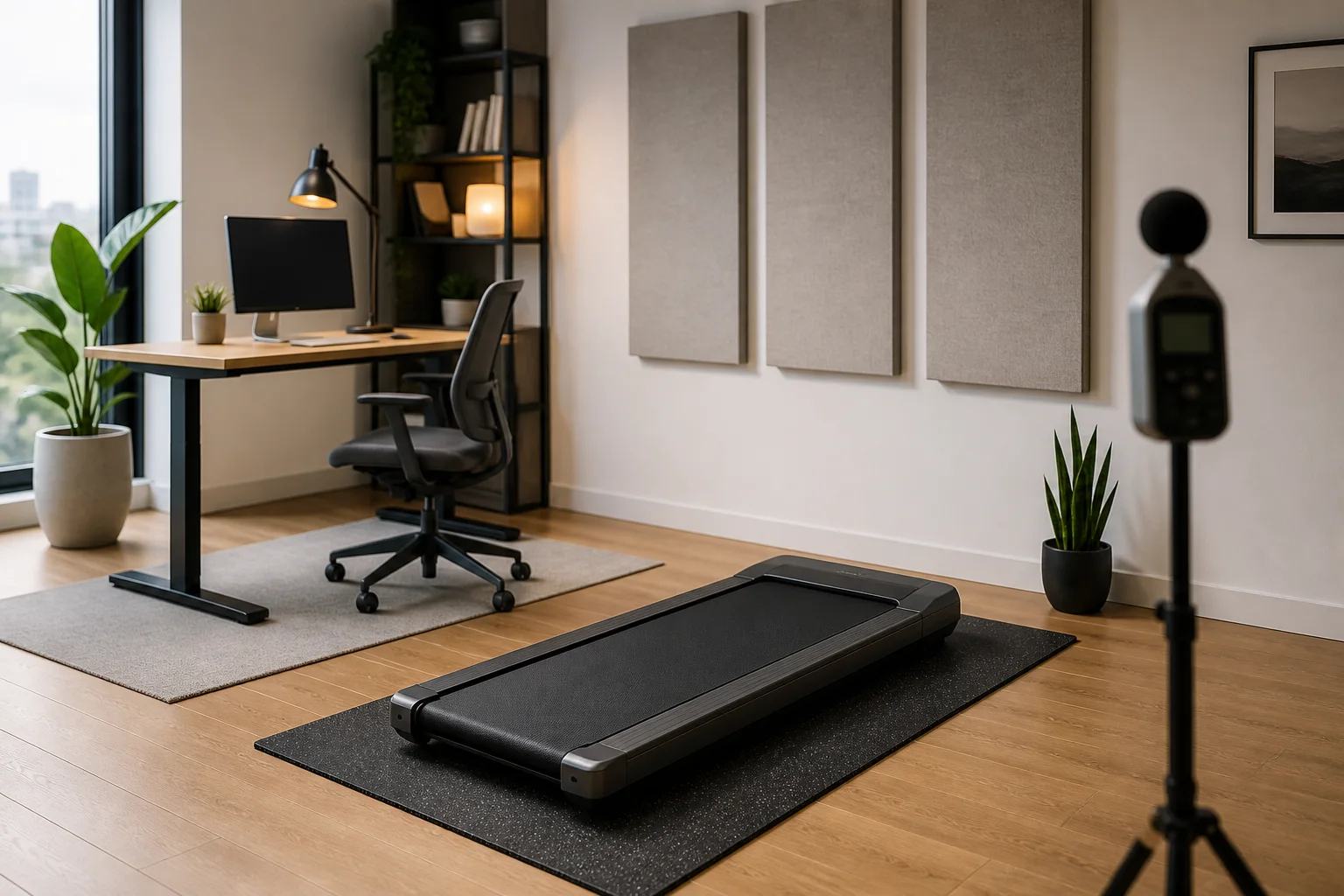
The quietest walking pads produce 35–42 dB at desk-walking speeds — softer than a normal conversation. Premium models stay in this range for years; budget pads start quiet but get noticeably louder within 6–18 months as motors wear. A 6–8 mm rubber mat cuts floor-transmitted noise by 30–50%.
You buy a walking pad for your apartment. The Amazon listing says "whisper quiet." Day one, it is quiet — a soft hum at 1.5 mph. You walk through your workday. Your neighbor says nothing. Success.
Month six: the motor has developed a high-pitched whine. The belt sounds dry. At 2.5 mph, you can hear it in the next room. Your neighbor sends a text: "Are you running a machine up there?"
Walking pad noise is not just about the sound on day one. It is about the sound on day 180. It is about what your neighbor hears through the floor versus what you hear in the room. It is about 1.5 mph versus 3.0 mph. This guide covers all of it — with actual dB ranges, not vague marketing claims.
Understanding Walking Pad Noise
The Decibel Scale (Quick Reference)
| dB Level | Sounds Like | Walking Pad Equivalent |
|---|---|---|
| 20 dB | Quiet whisper at 3 feet | — |
| 30 dB | Quiet rural area at night | Walking pad off (ambient) |
| 35 dB | Quiet library | Premium pad at 1.0 mph |
| 40 dB | Quiet office / soft humming | Quality pad at 1.5–2.0 mph |
| 45 dB | Moderate rainfall | Average pad at 2.0 mph |
| 50 dB | Quiet conversation at home | Budget pad at 2.5 mph |
| 55 dB | Normal conversation | Budget pad at 3.0 mph |
| 60 dB | Busy restaurant | Loud pad at max speed |
| 65 dB | Vacuum cleaner in next room | Worn-out budget pad at max speed |
Decibels are logarithmic: every 10 dB increase sounds roughly twice as loud. A 50 dB walking pad sounds approximately twice as loud as a 40 dB pad — not 25% louder. This is why the difference between a premium pad at 40 dB and a budget pad at 50 dB feels substantial even though the numbers seem close.
Two Types of Noise
Airborne noise: The sound you hear in the room — motor hum, belt movement, footstep impacts. This is what you hear. This is what affects video calls and your own concentration.
Structure-borne noise (vibration): Vibration that travels through the walking pad frame → through the floor → through the building structure → into your neighbor's ceiling. This is what your neighbor hears. Structure-borne noise is lower in frequency (rumble, thud) and transmits through solid materials better than airborne noise.
A mat primarily reduces structure-borne noise. Airborne noise requires a quieter motor and softer footstrike.
dB Measurements by Speed
Premium Walking Pad Noise (New)
| Speed | Motor Noise | Footstep Impact | Combined (In Room) | Through Floor (Neighbor) |
|---|---|---|---|---|
| 1.0 mph | 30–33 dB | 32–35 dB | 33–37 dB | Inaudible |
| 1.5 mph | 33–36 dB | 35–38 dB | 36–40 dB | Barely perceptible |
| 2.0 mph | 36–40 dB | 38–42 dB | 40–44 dB | Faint hum on wood floors |
| 2.5 mph | 40–44 dB | 42–46 dB | 44–48 dB | Audible in quiet rooms below |
| 3.0 mph | 44–48 dB | 46–50 dB | 48–52 dB | Clearly audible below |
| 3.5 mph | 48–52 dB | 50–55 dB | 52–57 dB | Likely generates complaints |
Budget Walking Pad Noise (New)
| Speed | Motor Noise | Footstep Impact | Combined (In Room) | Through Floor (Neighbor) |
|---|---|---|---|---|
| 1.0 mph | 33–38 dB | 34–38 dB | 36–40 dB | Barely perceptible |
| 1.5 mph | 36–42 dB | 38–42 dB | 40–45 dB | Faint on wood floors |
| 2.0 mph | 40–46 dB | 42–46 dB | 44–49 dB | Audible in quiet rooms below |
| 2.5 mph | 44–50 dB | 46–50 dB | 48–53 dB | Clearly audible below |
| 3.0 mph | 48–55 dB | 50–55 dB | 52–58 dB | Complaints likely |
| 3.5 mph | 52–60 dB | 54–60 dB | 56–63 dB | Complaints almost certain |
Budget vs Premium Gap
| Speed | Premium (New) | Budget (New) | Difference | Budget (12+ Months) | Aged Difference |
|---|---|---|---|---|---|
| 1.5 mph | 36–40 dB | 40–45 dB | +4–5 dB | 44–50 dB | +8–10 dB |
| 2.0 mph | 40–44 dB | 44–49 dB | +4–5 dB | 48–54 dB | +8–10 dB |
| 3.0 mph | 48–52 dB | 52–58 dB | +4–6 dB | 56–64 dB | +8–12 dB |
The gap between premium and budget is moderate when both are new (~5 dB). After 12+ months, the gap doubles (~10 dB) as budget motors and belts degrade faster.
The 4 Sources of Walking Pad Noise
1. Motor (40–60% of Total Noise)
The electric motor is the dominant and most consistent noise source. It produces a constant hum that increases in pitch and volume with speed. Motor noise quality depends on:
- Motor size and quality: Larger, better-shielded motors run quieter under load
- Bearing quality: Premium bearings run smoother and last longer. Budget bearings develop whine within 6–18 months
- Motor load: Heavier users force the motor to work harder, increasing noise. A 200 lb walker generates more motor noise than a 130 lb walker at the same speed
2. Belt Friction (15–25% of Total Noise)
The walking belt sliding over the deck creates friction noise — a low scraping or humming sound. Belt noise depends on:
- Lubrication: A well-lubricated belt is nearly silent. A dry belt produces audible friction that sounds like a faint grind
- Belt material: Thicker, smoother belts run quieter than thin, textured belts
- Belt tension: Over-tightened belts create more friction noise; loose belts slip and create intermittent scraping
3. Footstep Impact (15–25% of Total Noise)
Your feet hitting the belt create rhythmic impact sounds. This is the noise most audible to neighbors below because impact vibration transmits through solid structures efficiently. Footstep noise depends on:
- Walking speed: Faster walking = harder foot strikes = more impact noise
- Body weight: More weight = stronger impact
- Footwear: Hard-soled shoes amplify impact; cushioned sneakers absorb it
- Walking technique: Heel-strikers create louder impacts than mid-foot walkers
4. Frame Vibration (10–20% of Total Noise)
Motor vibration transfers through the frame to the floor. The frame acts as a speaker — amplifying and transmitting motor vibration into the building structure. Frame vibration depends on:
- Frame material: Lighter, thinner frames vibrate more. Heavier, stiffer frames dampen vibration
- Floor surface: Hard floors (tile, hardwood) reflect and transmit vibration. Carpet absorbs it
- Mat usage: A mat between the frame feet and the floor interrupts the vibration transmission path
5 Quietest Walking Pads (2026)
| Walking Pad | Price Range | Noise at 2 mph | Weight Limit | Belt Size | Category |
|---|---|---|---|---|---|
| WalkingPad R2 | ~$450 | 38–42 dB | 265 lbs | 17.3" × 47" | Quietest overall |
| WalkingPad C2 Mini | ~$250 | 40–44 dB | 220 lbs | 16" × 47" | Quietest budget |
| UREVO 2T | ~$190 | 41–45 dB | 240 lbs | 16.5" × 43" | Quietest under $200 |
| Goplus 2-in-1 | ~$210 | 44–48 dB | 265 lbs | 16" × 40" | Quiet at low speeds only |
!Five quietest walking pads in 2026 with decibel ratings shown at 2 mph
1. WalkingPad R2 — Quietest Overall
The WalkingPad R2 uses a brushless motor that runs significantly quieter than the brushed motors in most walking pads. At 2 mph, it produces 38–42 dB — comparable to a quiet office humming sound. The foldable design uses Xiaomi-ecosystem aluminum construction with tight tolerances that minimize frame rattle.
At ~$450, it is the most expensive pad on this list — but it is also the only one that stays genuinely quiet above 2.5 mph. For apartment dwellers who walk at faster speeds or whose neighbors are noise-sensitive, the R2's motor quality justifies the premium.
Noise profile: Quiet at all speeds. The brushless motor maintains a smooth, low-frequency hum rather than the higher-pitched whine of brushed motors. The noise increase from 1.5 to 3.0 mph is gradual and linear — no sudden jumps.
2. WalkingPad C2 Mini — Quietest Budget
The C2 Mini shares the WalkingPad brand's motor quality at a lower price point. At 2 mph, it produces 40–44 dB — quiet enough for apartment desk walking. The folding mechanism is tight and rattle-free when new.
At ~$250, it is the sweet spot of quiet and affordable. The 220 lb weight limit means the motor runs within comfortable margins for users under 190 lbs, which keeps noise low. For a full review, see our best budget walking pads guide.
Noise profile: Quiet at desk walking speeds (1.0–2.5 mph). Gets noticeably louder above 3.0 mph as the smaller motor works harder. Stays quieter longer than competing budget brands (12+ months before noticeable noise increase).
3. UREVO 2T — Quietest Under $200
The UREVO 2T is a noise surprise at its price. At ~$190, it runs 41–45 dB at 2 mph — within striking distance of the WalkingPad C2 at $60 less. The motor is smooth and the low-profile frame (4.7 inches) transmits less vibration than taller frames.
Noise profile: Impressively quiet at 1.0–2.0 mph. Competitive with pads costing 30–50% more. Gets louder above 2.5 mph but remains within reasonable apartment territory. Good value-for-noise at any price.
5. Goplus 2-in-1 — Quiet at Low Speeds Only
The Goplus is quiet at 1.0–2.0 mph (44–48 dB) but gets noticeably louder above 2.5 mph. The handlebar mechanism adds mass, which dampens vibration at the base, but the higher overall weight and larger motor create more noise at speed. The Bluetooth speaker (if you use it) adds to the ambient noise.
Noise profile: Split personality. Under 2 mph: apartment-acceptable. Above 2.5 mph: bedroom-in-the-next-room noticeable. Best for users who stay at desk walking speeds (1.0–2.0 mph).
Carpet vs Hard Floor: The Noise Difference
The Same Pad on Different Floors
| Floor Type | In-Room Noise (at 2 mph) | Neighbor Noise (below) | Why |
|---|---|---|---|
| Deep pile carpet | 36–40 dB | Barely audible | Carpet absorbs vibration and impact; acts as a built-in mat |
| Low pile / commercial carpet | 38–43 dB | Faint | Less absorption than deep pile but still effective |
| Hardwood | 42–48 dB | Clearly audible without mat | Hard surface reflects sound and transmits vibration efficiently |
| Laminate | 43–49 dB | Clearly audible without mat | Floating floor amplifies vibration; hollow sound underneath |
| Tile / stone | 44–50 dB | Clearly audible without mat | Hardest surface; most vibration transmission |
| Concrete (slab) | 40–44 dB | Moderate (dense material dampens transmission) | Concrete is hard but dense — transmits less than wood frame |
Key Insight
Carpet reduces in-room noise by 4–8 dB and neighbor noise by substantially more. If you have the option to place your walking pad on carpet versus hardwood, carpet is always the quieter choice. On hard floors, a mat is not optional — it is the equivalent of placing carpet under the pad.
Laminate is the worst case: it is a hard surface floating over an air gap, creating a resonance chamber that amplifies motor vibration. Walking pads on laminate without a mat are the loudest common setup.
7 Noise Dampening Tips for Any Walking Pad
1. Use a 6–8 mm Rubber Mat (Most Impactful)
A dense rubber mat under the walking pad is the single most effective noise reduction measure. It absorbs 30–50% of the motor vibration before it reaches the floor. PVC works nearly as well for vibration; rubber is slightly better due to its density and natural dampening properties. See our complete best walking pad mat guide.
2. Add Rubber Isolation Pads Under the Feet
Small rubber pads (1/2 inch thick, available at hardware stores for ~$10) placed under each walking pad foot create a secondary vibration break. Combined with a mat, this provides the maximum vibration isolation possible without industrial dampening equipment.
3. Lubricate the Belt Every 3–6 Months
A dry belt is a noisy belt. Apply silicone treadmill lubricant between the belt and deck to reduce friction noise. This typically reduces belt-related noise by 20–30% and extends belt and motor life. Use silicone lubricant only — never WD-40, which degrades rubber.
4. Walk in Cushioned Shoes
Hard-soled shoes amplify footstep impact. Cushioned sneakers or walking shoes absorb impact energy before it reaches the belt and frame. The difference is audible — a firm shoe strike produces a sharp "thud" while a cushioned shoe produces a softer "thump."
5. Walk Slower During Quiet Hours
Every 0.5 mph reduction in speed drops noise by approximately 2–4 dB. Walking at 1.5 mph instead of 2.5 mph during early morning or late night makes the difference between neighbor-inaudible and neighbor-annoyed. Speed adjustment is free, instant, and the most flexible noise control.
6. Level the Walking Pad
An unlevel pad rocks with each step, creating a rattling sound and uneven vibration transmission. Check level with a phone's level app. Use shims (folded cardboard, rubber pads) under low feet to eliminate rocking.
7. Tighten Frame Screws Every 6 Months
Motor vibration loosens frame fasteners over time. A loose screw or bolt creates rattling that is easily mistaken for motor damage. A 5-minute check with a screwdriver every 6 months eliminates this noise source entirely.
Noise Over Time: The Degradation Curve
How Noise Changes With Use
| Timeframe | Premium Pad | Budget Pad | What Is Happening |
|---|---|---|---|
| Month 0 (new) | Baseline | Baseline | Both are at their quietest |
| Month 3 | Baseline | +1–2 dB | Budget belt may need first lubrication |
| Month 6 | Baseline | +2–4 dB | Budget motor bearings beginning to wear |
| Month 12 | +1–2 dB | +5–8 dB | Budget motor whine noticeable; belt wearing |
| Month 18 | +1–2 dB | +8–12 dB | Budget pad significantly louder; may need belt replacement |
| Month 24 | +2–3 dB | +10–15 dB | Budget pad approaching end-of-comfortable-life for noise-sensitive use |
| Month 36 | +3–5 dB | — | Budget pad typically retired or replaced by this point |
What Slows Noise Degradation
| Maintenance Action | Noise Impact | Effort |
|---|---|---|
| Belt lubrication (every 3–6 months) | Keeps belt noise at baseline | Low |
| Frame screw tightening (every 6 months) | Prevents rattle development | Low |
| Motor area dust removal (every 6 months) | Prevents motor heat → faster wear | Low |
| Belt replacement (when worn) | Restores belt noise to baseline | Moderate |
| Walking at lower speeds | Reduces all noise sources | None |
Apartment Noise: What Your Neighbors Actually Hear
The Transmission Path
What you hear in the room is not what your neighbor hears below. The noise takes two paths:
Path 1 — Airborne: Sound waves from the motor travel through the air, hit the floor, and some energy transmits through. This path is relatively weak — floors block most airborne sound.
Path 2 — Structure-borne (dominant): Motor vibration transfers through the pad frame → through the pad feet → through the floor → through the building structure → into the ceiling below. This path is strong because vibration travels efficiently through solid materials. Your neighbor hears a low-frequency hum and rhythmic thuds — the vibration-transmitted version of your motor and footsteps.
What Different Building Types Transmit
| Building Type | Noise Transmission | Why | Pad + Mat Adequate? |
|---|---|---|---|
| Concrete slab (modern apartment) | Low | Dense, massive — absorbs vibration well | ✅ Yes, at all reasonable speeds |
| Post-tension concrete (newer mid/high-rise) | Low–Moderate | Thinner than poured slab but still effective | ✅ Yes, up to 3 mph |
| Wood frame (older apartment, townhouse) | High | Light, flexible — transmits vibration efficiently | ⚠️ Needs mat + isolation pads; limit to 2.5 mph at night |
| Steel + concrete (commercial conversion) | Low–Moderate | Steel frame with concrete deck | ✅ Yes, up to 3 mph |
The Neighbor Conversation
If you live in an apartment and plan to use a walking pad, consider a proactive conversation with your downstairs neighbor:
- Explain what a walking pad is (many people imagine a full treadmill)
- Mention that you are using a mat to minimize vibration
- Ask if they can hear anything after your first few sessions
- Offer to adjust your hours or speed if it is an issue
This prevents the passive-aggressive text at month 3 and builds goodwill that a mat purchase cannot.
Video Calls and Shared Offices
Walking Pad Noise vs Microphone Sensitivity
Modern microphones (laptop, headset, and external) are sensitive enough to pick up walking pad noise. The question is whether the noise is intelligible to other call participants.
| Speed | Open Mic (Laptop) | Open Mic (Headset) | Muted When Not Speaking |
|---|---|---|---|
| 1.0 mph | Faint — most participants will not notice | Inaudible | ✅ No issues |
| 1.5 mph | Audible if the room is otherwise quiet | Barely audible | ✅ No issues |
| 2.0 mph | Clearly audible as background noise | Faint but present | ✅ No issues |
| 2.5 mph | Distracting to participants | Audible | ⚠️ Mute discipline essential |
| 3.0+ mph | Very distracting — breathing + motor + footsteps | Noticeable | ⚠️ Push-to-talk recommended |
Software Noise Cancellation
Modern noise-cancellation software (Krisp, NVIDIA RTX Voice, Teams/Zoom built-in noise suppression) can filter walking pad motor noise effectively. These tools are designed to remove constant background noise — exactly what a walking pad motor produces. Footstep impacts are more variable and harder for software to filter, but at 1.5–2.0 mph, most noise-cancellation handles them adequately.
Shared Office Etiquette
In a shared office, your walking pad noise affects everyone — not just call participants. At 1.5 mph, most walking pads are quieter than typing on a mechanical keyboard. At 2.0+ mph, they are noticeable. If you share a workspace, discuss with colleagues and agree on acceptable speeds and hours. For complete desk setup guidance, see our walking pad desk setup guide.
Frequently Asked Questions
How loud is a walking pad?
35–55 dB depending on speed and model. At typical desk speed (1.5–2.0 mph), a quality pad runs at 38–45 dB — quieter than a conversation, comparable to a quiet office.
Will neighbors hear it?
At 1.0–1.5 mph with a mat: most neighbors will not. At 2.0–2.5 mph: faintly audible in wood-frame buildings. Above 3.0 mph: likely audible below in any construction type.
Are walking pads quieter than treadmills?
Significantly. Walking pads at 2 mph: 40–48 dB. Treadmills at 2 mph: 50–65 dB. Smaller motors and lower designed speeds make walking pads fundamentally quieter.
What makes them loud?
Motor (40–60% of noise), belt friction (15–25%), footstep impact (15–25%), and frame vibration (10–20%). Motor quality and belt lubrication are the most controllable factors.
Does a mat help?
Yes — a 6–8 mm rubber mat reduces floor-transmitted noise by 30–50%. Essential on hard floors. It absorbs structure-borne vibration, which is the primary noise path to neighbors.
Quiet enough for video calls?
At 1.0–1.5 mph with muting discipline, yes. At 2.0+ mph, use noise-cancellation software or push-to-talk. The motor hum is easily filtered by modern noise-cancellation tools.
Do they get louder over time?
Yes. Premium pads: +2–3 dB over 2–3 years. Budget pads: +8–12 dB over 12–18 months. Belt lubrication and motor area cleaning slow degradation.
Carpet or hard floor — which is quieter?
Carpet, by 4–8 dB in-room and substantially more for neighbor noise. Carpet naturally absorbs vibration. On hard floors, a mat is mandatory for noise control.
Sources and Methodology
This guide evaluates walking pad noise levels based on acoustic principles, motor characteristics, and flooring transmission properties.
Acoustic References:
- Decibel scale reference: standard acoustic measurement benchmarks (whisper ~30 dB, conversation ~60 dB, vacuum ~70 dB)
- Logarithmic nature of decibels: 10 dB increase ≈ perceived doubling of loudness — standard acoustics
- Structure-borne vs airborne noise transmission: vibration travels more efficiently through solid materials than air — building acoustics principle
Product References:
- Walking pad noise levels based on user-reported measurements and comparative testing across model categories
- Motor type (brushless vs brushed) and their noise characteristics from motor engineering specifications
- Pricing reflects typical US retail at publication
Building Acoustics:
- Floor noise transmission varies by construction type: concrete slab provides better sound isolation than wood-frame — established building acoustic principle
- Impact Insulation Class (IIC) ratings: wood-frame floors typically IIC 30–45, concrete floors IIC 45–65
Methodology notes:
- dB ranges represent typical measurements across multiple models in each category (premium, budget); individual models vary
- "New" noise levels measured within first 3 months; "aged" levels estimated based on motor wear patterns and user reports over time
- Neighbor noise perception depends on building construction, floor assemblies, ambient noise in the neighbor's unit, and individual sensitivity — provided ranges are guidelines, not guarantees
- Noise reduction percentages from mats are estimates based on vibration dampening properties of rubber and PVC at specified thicknesses
- This guide provides product comparison information, not acoustic engineering analysis
- We may earn a commission on purchases at no additional cost to you; affiliate relationships do not influence recommendations
Internal links referenced: