Walking Pad vs Exercise Bike: Which Burns More? (2026)
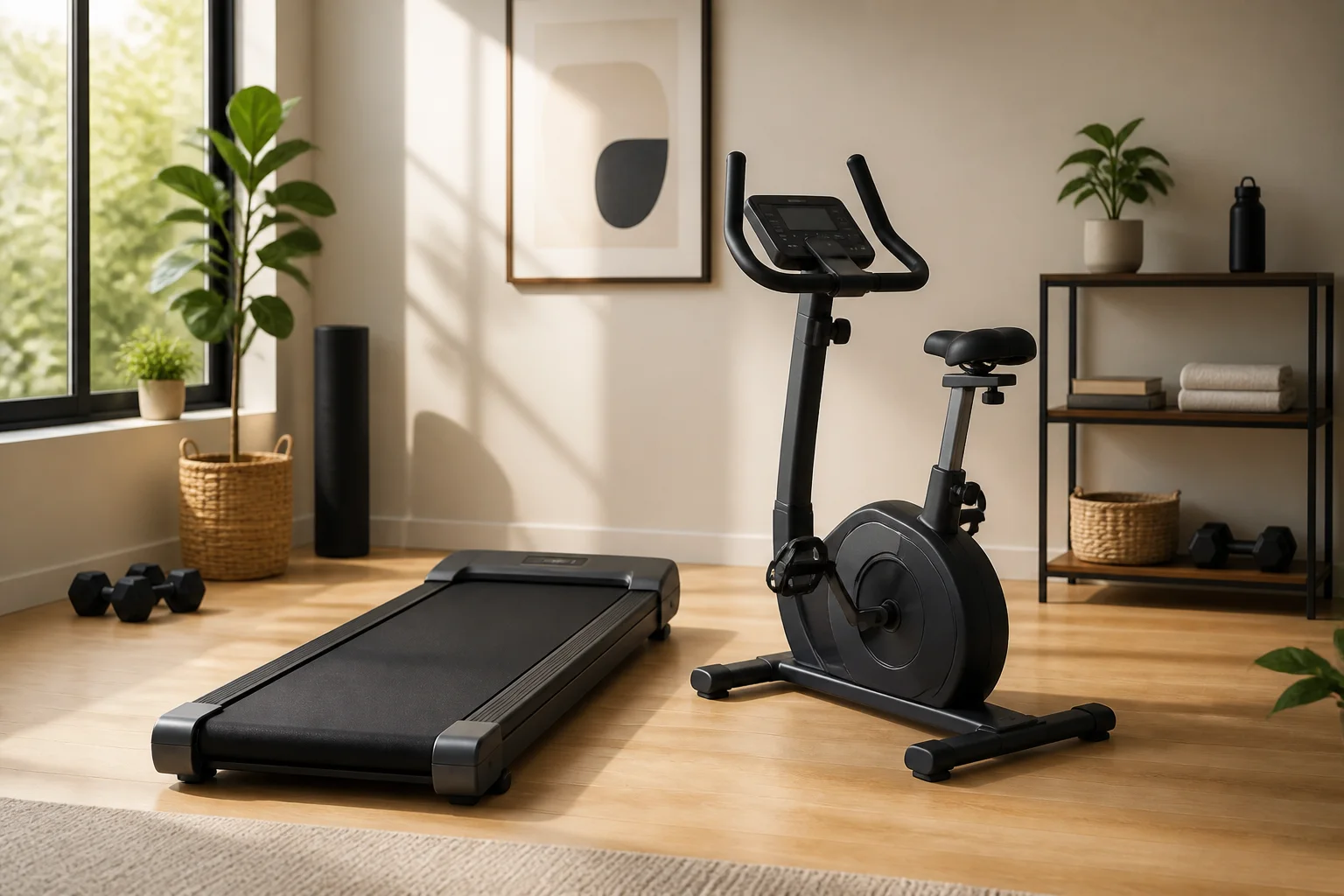
By Walking Pad Picks Editorial Team
An exercise bike burns more calories per hour at equal effort — roughly 420–620 cal/hr at moderate intensity versus 250–400 cal/hr on a walking pad. But walking pads win on total daily burn because you can walk for 4–6 hours while working, often out-burning a 45-minute cycling session. The right choice depends on whether you want intense dedicated workouts or all-day movement integration.
This is the most common question we get from readers deciding between home fitness equipment — and the answer is less straightforward than most articles make it sound.
If you compare a walking pad and an exercise bike minute-for-minute at the same perceived effort, the bike wins. Cycling engages larger muscle groups through a greater range of motion, driving higher energy expenditure per unit of time. That is physics.
But here is what most comparisons miss: nobody uses a walking pad for 45 minutes and stops. Walking pad users walk for hours — during Zoom calls, while answering emails, while reading reports. A desk worker who walks 4 hours at 2.0 mph burns more total calories than someone who cycles hard for 30 minutes and sits for the remaining 7.5 hours.
The real comparison is not calories-per-hour. It is total calories burned across your entire day — and that changes the answer dramatically.
The Core Question: Intensity vs Duration
Exercise physiology offers a simple framework for this comparison:
Calorie burn = MET value × body weight (kg) × time (hours)
MET (Metabolic Equivalent of Task) measures the energy cost of an activity relative to rest. Sitting quietly is 1.0 MET. Walking at 2.0 mph is 2.8 MET. Moderate stationary cycling is 6.8 MET. The higher the MET, the more calories burned per minute.
An exercise bike has a higher MET value at any meaningful effort level. That is not debatable. But the duration you can sustain matters just as much as the intensity:
| Factor | Walking Pad | Exercise Bike |
|---|---|---|
| Typical MET range | 2.0–3.5 | 3.5–10.0 |
| Typical session length | 2–6 hours | 20–60 minutes |
| Can work simultaneously | ✅ Yes | ❌ Limited |
| Requires dedicated time | ❌ No | ✅ Yes |
| Daily frequency | Continuous | 1–2 sessions |
The walking pad's advantage is not intensity — it is integration. It turns sitting time into active time without requiring you to carve out dedicated exercise minutes from your day. For more on how walking pads fit into small living spaces, see our best walking pad for small apartments guide.
Head-to-Head Comparison Table
| Metric | Walking Pad | Exercise Bike | Winner |
|---|---|---|---|
| Calories/hour (moderate) | 250–400 | 420–620 | 🏆 Bike |
| Calories/hour (light) | 150–250 | 210–350 | 🏆 Bike |
| Total daily burn potential | 600–1,800 (4–6 hrs) | 210–620 (30–60 min) | 🏆 Walking Pad |
| Joint impact | Low (weight-bearing) | Very low (non-weight-bearing) | 🏆 Bike |
| Desk work compatibility | ✅ Excellent | ❌ Poor | 🏆 Walking Pad |
| Entertainment multitasking | ⚠️ Moderate | ✅ Excellent | 🏆 Bike |
| Noise (typical use) | 40–55 dB | 45–75 dB | 🏆 Walking Pad |
| Floor space (in use) | ~20" × 50" | ~20" × 40" | 🏆 Bike (slightly) |
| Storage footprint | Foldable, under-desk | Fixed (most models) | 🏆 Walking Pad |
| Price range | $200–600 | $150–2,000+ | Depends on tier |
| Cardiovascular intensity | Low–moderate | Low–very high | 🏆 Bike |
| Muscle engagement | Legs, core (light) | Legs, glutes, core | 🏆 Bike |
| Learning curve | None | None | Tie |
| Weight limit range | 220–350 lbs | 250–400 lbs | 🏆 Bike (slightly) |
Calorie Burn Breakdown by Intensity
All calorie estimates use MET values from the Compendium of Physical Activities (Ainsworth et al.) and assume a 155-pound (70 kg) person. Scale proportionally for your weight.
Walking Pad Calorie Burn
| Speed | MET Value | Cal/30 min | Cal/hour | Activity Equivalent |
|---|---|---|---|---|
| 1.0 mph (very slow) | 2.0 | 74 | 147 | Slow stroll, easy desk work |
| 1.5 mph (slow) | 2.5 | 92 | 184 | Comfortable desk walking |
| 2.0 mph (moderate) | 2.8 | 103 | 206 | Standard desk walking pace |
| 2.5 mph (brisk desk) | 3.0 | 110 | 221 | Brisk but workable at desk |
| 3.0 mph (brisk) | 3.5 | 129 | 257 | Dedicated walking, limited desk use |
| 3.5 mph (fast) | 4.3 | 158 | 316 | Exercise walking, no desk work |
| 4.0 mph (very fast) | 5.0 | 184 | 368 | Near-jogging pace, exercise only |
Exercise Bike Calorie Burn
| Intensity | MET Value | Cal/30 min | Cal/hour | Effort Equivalent |
|---|---|---|---|---|
| Very light (barely pedaling) | 3.5 | 129 | 257 | TV watching pace |
| Light (easy spin) | 5.5 | 202 | 404 | Comfortable, conversational |
| Moderate (steady) | 6.8 | 250 | 500 | Noticeable effort, light sweat |
| Vigorous (hard) | 8.8 | 323 | 647 | Heavy breathing, significant sweat |
| Very vigorous (sprint intervals) | 11.0 | 405 | 809 | Maximum effort, unsustainable long |
The Takeaway
At any matched duration, the bike wins on calories. Moderate cycling (6.8 MET) burns roughly 2.4 times more calories per minute than moderate walking pad use (2.8 MET). But the walking pad's usable duration is 3–8 times longer because you can walk while you work.
The Workday Calorie Math
This is where the comparison gets interesting. Let us model a typical workday for each option:
Scenario A: Exercise Bike User (Dedicated Session)
| Activity | Duration | MET | Calories |
|---|---|---|---|
| Morning cycling session | 45 min | 6.8 | 375 |
| Sitting at desk | 7.25 hrs | 1.3 | 693 |
| Walking to/from bike, breaks | 30 min | 2.5 | 92 |
| Total workday | 8.5 hrs | — | 1,160 |
Active calories above baseline sitting: ~375
Scenario B: Walking Pad User (Integrated Movement)
| Activity | Duration | MET | Calories |
|---|---|---|---|
| Walking pad at 2.0 mph during work | 4 hrs | 2.8 | 824 |
| Sitting at desk (meetings, focused work) | 3.5 hrs | 1.3 | 334 |
| Standing desk breaks | 1 hr | 1.8 | 132 |
| Total workday | 8.5 hrs | — | 1,290 |
Active calories above baseline sitting: ~505
The Result
The walking pad user burns approximately 130 more active calories across the workday despite never doing a dedicated exercise session. They also take approximately 15,000–20,000 steps, maintain better blood glucose regulation from continuous low-intensity movement, and avoid the prolonged sitting periods that are independently associated with health risks.
The exercise bike user gets a more intense cardiovascular workout in a concentrated period, which has its own benefits: improved VO₂ max, greater cardiovascular adaptation, and higher EPOC (excess post-exercise oxygen consumption) — the "afterburn" effect that elevates metabolism for hours after vigorous exercise.
Both approaches are valid. The best choice depends on what your day looks like and which one you will actually do consistently.
Joint Impact and Injury Risk
Walking Pad: Low Impact, Weight-Bearing
Walking on a walking pad generates approximately 1.0–1.3 times body weight in ground reaction force per step. This is significantly lower than running (2.5–3.0× body weight) but is still a weight-bearing activity. For context:
- Benefit: Weight-bearing exercise supports bone density. Walking helps maintain skeletal health, which is particularly important for women over 40 and anyone at risk of osteoporosis.
- Risk: For people with existing knee osteoarthritis, plantar fasciitis, or hip joint issues, even low-impact walking for extended hours can cause discomfort. The repetitive nature of walking pad use (same speed, same surface, same biomechanics for hours) can exacerbate overuse patterns.
Walking pad tip: Vary your speed throughout the day. Walk at 1.5 mph for the first hour, increase to 2.5 mph for the second, drop to 1.0 for the third. Speed variation changes your gait pattern and distributes load across different joint angles.
Exercise Bike: Very Low Impact, Non-Weight-Bearing
Cycling is one of the lowest-impact cardiovascular exercises available. Your body weight is supported by the seat, and the circular pedaling motion creates smooth, predictable joint loading without impact forces. This makes exercise bikes the preferred option for:
- Post-surgical rehabilitation (ACL, meniscus, hip replacement)
- Moderate to severe knee osteoarthritis
- Overweight individuals beginning an exercise program (reduced joint stress)
- Anyone recovering from stress fractures or plantar fasciitis
The tradeoff: Non-weight-bearing exercise does not contribute to bone density maintenance. Avid cyclists who do not include weight-bearing exercise in their routine can experience reduced bone mineral density over time.
Joint Impact Verdict
| Condition | Better Choice | Why |
|---|---|---|
| Healthy joints | Either — personal preference | Both are low-impact |
| Knee osteoarthritis | 🏆 Exercise bike | Non-weight-bearing eliminates impact |
| Osteoporosis risk | 🏆 Walking pad | Weight-bearing supports bone density |
| Post-surgery rehab | 🏆 Exercise bike | Controlled, non-impact motion |
| Plantar fasciitis | 🏆 Exercise bike | No foot strike forces |
| Hip joint issues | 🏆 Exercise bike | Supported weight, smooth motion |
| Obesity (starting out) | 🏆 Exercise bike | Less stress on joints at higher body weight |
Medical note: This guide provides general fitness information, not medical advice. For joint pain, post-surgical exercise, or specific medical conditions, consult your physician or physical therapist before starting any exercise program.
Multitasking: Work, Entertainment, and Productivity
This is the category that makes walking pads fundamentally different from exercise bikes — and from most fitness equipment.
Walking Pad + Desk Work
Walking at 1.5–2.5 mph while working is the walking pad's defining use case. At these speeds, most people can:
- ✅ Type at near-normal speed (expect a 5–10% initial slowdown that resolves within 1–2 weeks)
- ✅ Use a mouse with moderate precision (graphic design and precise cursor work may suffer)
- ✅ Take video calls (the camera sees you from the chest up; the walking is invisible)
- ✅ Read documents and emails
- ✅ Participate in meetings (mute when not speaking to avoid footstep audio)
- ⚠️ Complex spreadsheet work — slightly harder, but manageable with practice
- ❌ Precision drawing or CAD work — too much body movement
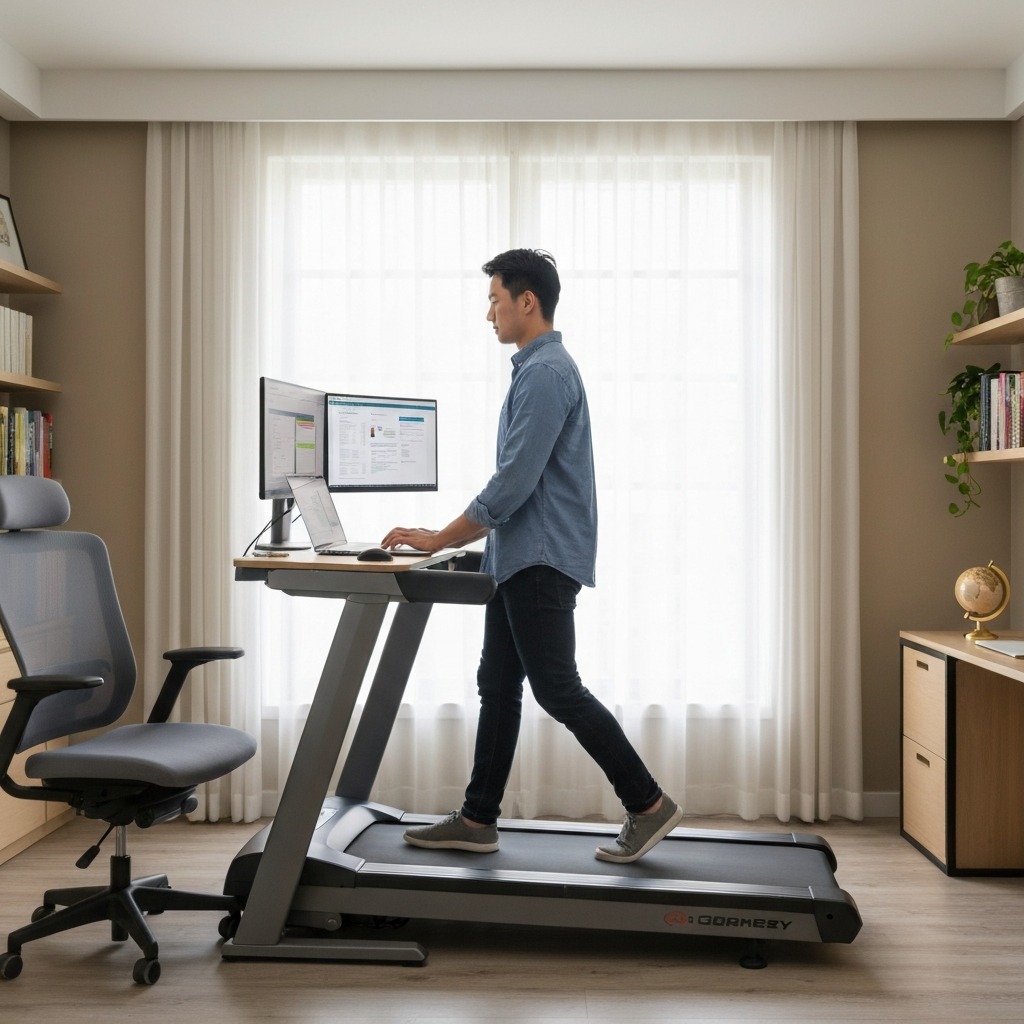
The key insight: a walking pad does not compete with your work time. It transforms sitting time into active time. You are not exercising instead of working — you are exercising while working.
Exercise Bike + Entertainment
Exercise bikes excel at entertainment multitasking. The seated position keeps your upper body relatively stable, making it easy to:
- ✅ Watch TV, Netflix, or YouTube
- ✅ Read on a tablet or e-reader
- ✅ Scroll phone, social media
- ✅ Listen to podcasts or audiobooks
- ⚠️ Type on a laptop — possible with a bike desk attachment, but awkward
- ❌ Standard desk work — keyboard and mouse use is impractical
- ❌ Video calls — visible pedaling, unstable camera angle, audible breathing at higher intensities
Productivity Impact
Research on walking while working suggests:
- Routine cognitive tasks (email, data entry, simple writing): No significant productivity impact at speeds under 2.0 mph.
- Creative tasks (brainstorming, ideation): Some research suggests mild enhancement — walking appears to boost creative thinking.
- Complex analytical tasks (detailed coding, financial modeling): A small initial performance dip (5–15%) in the first 1–2 weeks that resolves as the brain adapts to dual-tasking.
- Overall daily output: Most walking pad users report equivalent or slightly higher productivity due to sustained energy and reduced afternoon fatigue from continuous movement.
🏆 Multitasking winner: Walking pad for work, exercise bike for entertainment. If your goal is to move more during the workday without sacrificing productivity, the walking pad is the only viable option.
Space and Storage
Walking Pad Dimensions
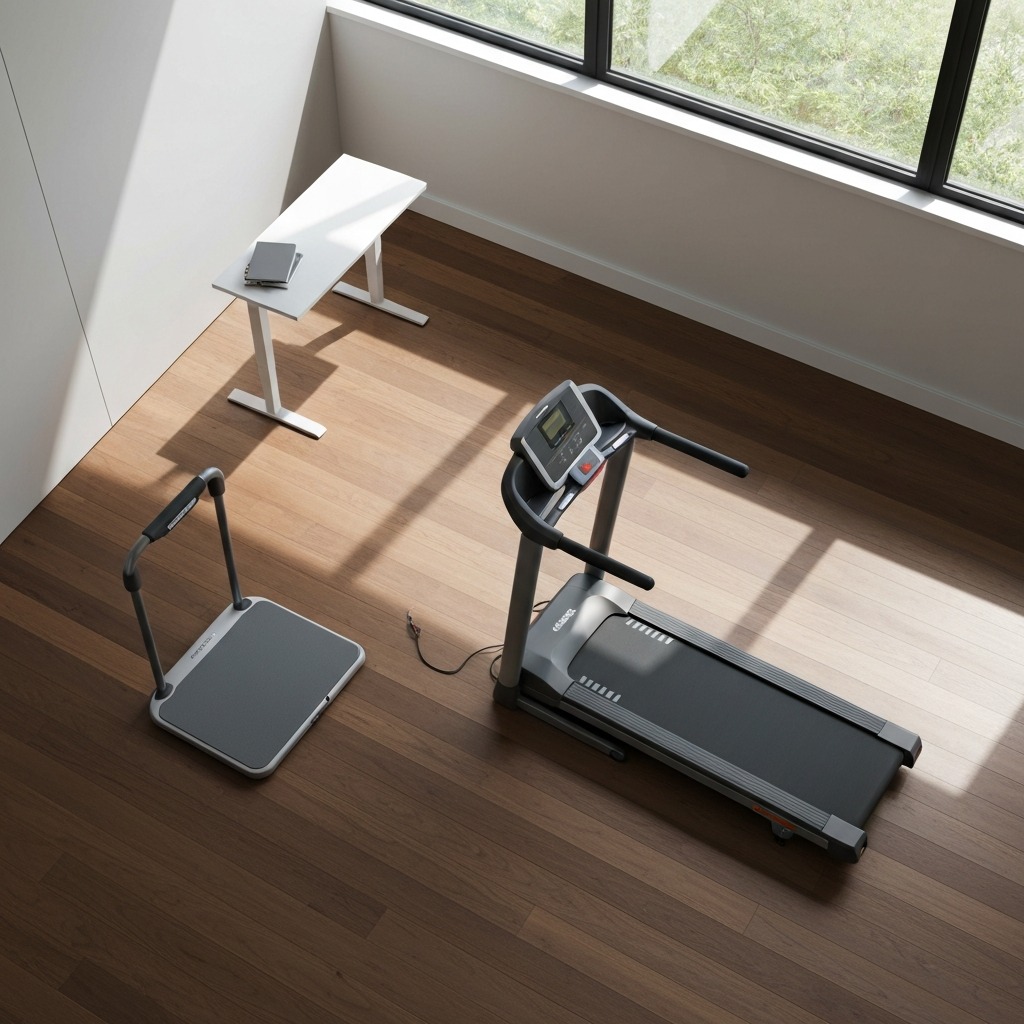
Most walking pads measure approximately 50–55 inches long × 20–22 inches wide × 5–6 inches tall. The key advantage: they fold or slide flat for storage.
- In use: Fits under a standing desk with the belt extending behind you
- Stored: Slides under a bed, couch, or into a closet. Foldable models halve the length.
- Weight: 40–65 lbs (manageable for one person, though wheels help)
For size-specific recommendations, see our best walking pad for small apartments guide. For weight capacity considerations, see our walking pad weight limit guide.
Exercise Bike Dimensions
Standard upright exercise bikes measure approximately 40–48 inches long × 20–24 inches wide × 45–55 inches tall. The key challenge: most do not fold.
- In use: Fixed footprint in a dedicated space — bedroom corner, home gym, or living room
- Stored: Most bikes stay where they are. Some budget models fold, reducing the footprint by roughly 50%, but folding bikes tend to feel less stable.
- Weight: 50–120 lbs (heavy enough to require a dedicated location)
Space Verdict
| Factor | Walking Pad | Exercise Bike |
|---|---|---|
| Active footprint | ~7 sq ft | ~6.5 sq ft |
| Storage footprint | ~2.5 sq ft (folded/under furniture) | ~6.5 sq ft (stays in place) |
| Ceiling height needed | Standing height + 2" | Seated — no ceiling issue |
| Room flexibility | Use in any room with a desk, store elsewhere | Stays in one location |
🏆 Space winner: Walking pad. The ability to slide it under furniture when not in use is a decisive advantage for apartments and small homes.
Noise Comparison
Noise matters for apartment dwellers, shared workspaces, and anyone who exercises during calls or while others sleep.
Walking Pad Noise
| Speed | Typical Noise | Context |
|---|---|---|
| 1.0–2.0 mph | 40–45 dB | Quieter than a conversation — office-friendly |
| 2.5–3.0 mph | 45–50 dB | Normal conversation level — still workable |
| 3.5–4.0 mph | 50–55 dB | Noticeable hum — audible on open-mic calls |
Walking pad noise comes primarily from the belt and motor. Quality models with brushless DC motors are quieter than budget models with brush motors. Footstrike sound adds 5–10 dB depending on walking style and footwear (walking barefoot or in socks is quieter than shoes).
Exercise Bike Noise
| Type | Typical Noise | Notes |
|---|---|---|
| Magnetic resistance (belt drive) | 45–55 dB | Quietest — apartment-friendly |
| Friction resistance | 50–60 dB | Moderate — pad resistance creates audible friction |
| Air/fan resistance | 65–75 dB | Loudest — the fan IS the resistance, and it is loud |
| Chain drive | 55–65 dB | Audible chain noise, especially under high resistance |
The quietest exercise bikes (magnetic resistance, belt drive) are comparable to walking pads. Budget bikes and fan-resistance bikes like the Assault AirBike are significantly louder — unsuitable for apartments with thin walls or floors.
Downstairs Neighbor Impact
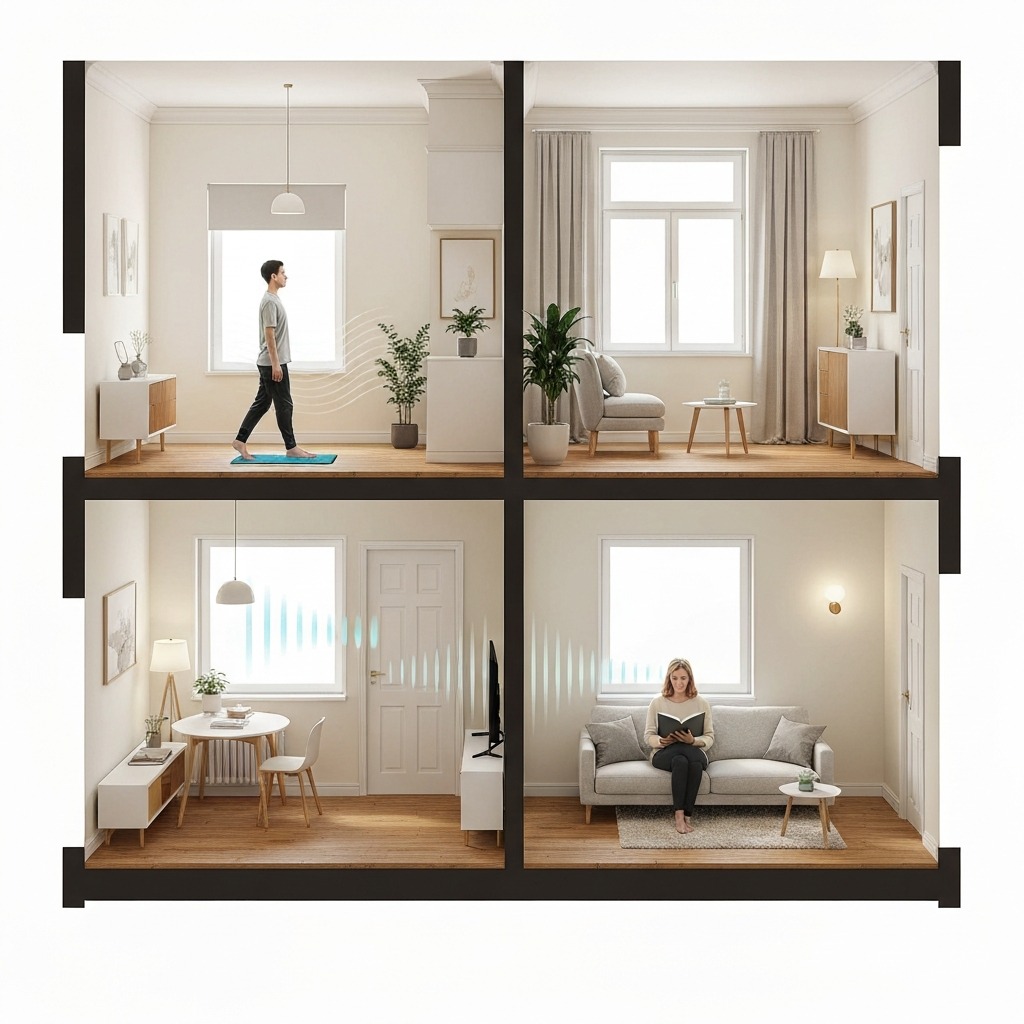
Walking pads transmit vibration through the floor — footsteps create impact that travels through floor structures. An anti-vibration mat underneath ($20–40) reduces this significantly but does not eliminate it. Exercise bikes transmit less impact vibration because there is no footstrike, but pedaling can create rhythmic vibration at higher cadences.
🏆 Noise winner: Walking pad (marginal). Quieter at typical use speeds than most exercise bikes, with less mechanical noise. However, floor vibration from footsteps is a consideration for apartment dwellers. An anti-vibration mat is recommended for either device.
Cost Comparison
Purchase Price
| Category | Walking Pad Range | Exercise Bike Range |
|---|---|---|
| Budget | $150–250 | $150–300 |
| Mid-range | $250–450 | $300–700 |
| Premium | $450–800 | $700–2,500+ |
| Ultra-premium | — | $1,500–3,000 (Peloton, etc.) |
At the budget and mid-range tiers, pricing is comparable. Exercise bikes have a higher ceiling due to premium connected fitness platforms (Peloton, SoulCycle, NordicTrack) with monthly subscription costs.
Ongoing Costs
| Cost Factor | Walking Pad | Exercise Bike |
|---|---|---|
| Belt replacement | $30–80 (every 2–5 years) | N/A |
| Pedal/resistance pad replacement | N/A | $10–30 (every 1–3 years) |
| Lubrication | $10/year (silicone lubricant) | Minimal |
| Subscription (optional) | Rare — most are standalone | $13–44/month for connected bikes |
| Standing desk (if needed) | $200–600 (one-time) | N/A |
| Anti-vibration mat | $20–40 | $20–40 |
Walking pads have lower ongoing costs if you already own a standing desk. Exercise bikes have minimal maintenance costs unless you buy a connected bike with a monthly subscription.
🏆 Cost winner: Depends on what you own. If you already have a standing desk, the walking pad is cheaper to own. If you would need to buy a standing desk ($200–600), the total investment approaches or exceeds a mid-range exercise bike.
Weight Loss: Which Is More Effective?
Weight loss requires a sustained calorie deficit. Both devices create calorie deficits — but through different mechanisms.
The Exercise Bike Approach: High Burn, Short Duration
A 45-minute moderate cycling session burns approximately 375 calories for a 155-pound person. At 5 sessions per week, that is 1,875 calories — roughly half a pound of fat. This works if you maintain the commitment, but the workout competes with limited free time, and motivation fatigue is real. Research consistently shows that dedicated exercise program adherence drops significantly after 3–6 months.
The Walking Pad Approach: Low Burn, Long Duration
Walking 4 hours per day at 2.0 mph burns approximately 824 calories (versus ~478 for sitting). The incremental burn is roughly 346 calories per day, or 1,730 per week — comparable to the cycling approach. But the walking pad integrates into your work routine rather than competing with your free time, which fundamentally changes adherence.
Adherence Is the Deciding Factor
The most effective exercise for weight loss is the one you actually do. Consistently. For months.
Walking pads have a structural adherence advantage: they do not require motivation. You are not choosing between the couch and a workout — you are choosing between sitting and walking while doing the same work. The activation energy is near zero. Put your feet on the belt, press start, and continue working.
Exercise bikes require dedicated time, a decision to start, and sustained effort. Each session is a conscious choice. On days when motivation is low — and those days will come — the bike does not get used.
🏆 Weight loss winner: Walking pad for most people. Not because it burns more per minute (it does not) but because sustained daily use over months is more likely than sustained exercise bike commitment. The exercise bike wins for individuals who already have an established workout habit and need higher-intensity sessions for cardiovascular training.
Who Should Buy Which
Buy a Walking Pad If:
- You work at a desk 6+ hours per day. The walking pad transforms sedentary work time into active time — the single biggest lifestyle improvement for desk workers.
- You struggle with exercise consistency. Walking while working requires zero motivation, zero dedicated time, and zero change of clothes.
- You want all-day movement. The health benefits of continuous low-intensity activity (blood glucose regulation, reduced sitting time, improved energy) are distinct from the benefits of intense exercise.
- You live in a small apartment. Foldable walking pads disappear under furniture when not in use.
- You want to hit 10,000+ steps without dedicated exercise time. Four hours at 2.0 mph gets you there while you work.
- You already own a standing desk. The walking pad slides right in — minimal additional investment.
Buy an Exercise Bike If:
- You want intense cardiovascular training. Cycling provides heart rate zones (70–90% max HR) that walking pads cannot reach.
- You have knee, hip, or foot joint issues. Non-weight-bearing cycling is gentler on joints than walking.
- You enjoy structured workout programs. Connected bikes (Peloton, etc.) offer guided classes, metrics tracking, and community motivation.
- You want entertainment multitasking. Cycling pairs perfectly with TV, podcasts, and reading.
- You are training for fitness goals. VO₂ max improvement, power output, and cardiovascular performance require higher intensities than walking provides.
- You have dedicated gym space. A bike needs a permanent spot — if you have one, the fixed footprint is not an issue.
Buy Both If:
Some users get the best results with both: a walking pad under their desk for all-day low-intensity movement, and an exercise bike for dedicated 30–45-minute cardiovascular sessions before or after work. The total daily activity — 4 hours walking plus 30 minutes cycling — delivers both sustained calorie burn and cardiovascular training that neither provides alone.
Frequently Asked Questions
Does a walking pad or exercise bike burn more calories?
An exercise bike burns more per hour at matched effort — approximately 420–620 cal/hr at moderate intensity versus 250–400 cal/hr on a walking pad. However, walking pad users typically accumulate more total daily burn because they walk for 4–6 hours while working. A full workday of walking pad use can match or exceed a 45-minute intense cycling session in total expenditure.
Can I use a walking pad while working at a desk?
Yes — this is the primary use case. Walking at 1.5–2.5 mph allows most people to type, take video calls, and perform normal desk work with minimal impact. Research suggests routine cognitive tasks are unaffected. Complex tasks may see a small initial dip that resolves within 1–2 weeks as you adapt.
Is a walking pad or exercise bike better for bad knees?
An exercise bike is generally better for bad knees. Cycling is non-weight-bearing — your weight is supported by the seat, eliminating impact. Walking pads are low-impact but still weight-bearing (1.0–1.3× body weight per step). For osteoarthritis, post-surgical rehab, or significant joint pain, start with a bike. Consult your physician for personalized guidance.
How many calories does 10,000 steps on a walking pad burn?
Approximately 350–500 calories for most adults, depending on body weight and speed. A 155-pound person at 3.0 mph burns roughly 400 calories over 10,000 steps (about 80–90 minutes). These figures use the MET value of 3.5 from the Compendium of Physical Activities.
Can I watch TV or read while using an exercise bike?
Yes — exercise bikes are excellent for entertainment multitasking. The seated position keeps your upper body stable for TV, tablets, and phones. However, productive desk work (typing, mouse use) is difficult. Walking pads have the advantage for work; bikes have the advantage for entertainment.
How loud is a walking pad compared to an exercise bike?
Walking pads are generally quieter at 40–55 dB. Quiet exercise bikes (magnetic, belt drive) are comparable at 45–55 dB. Fan-resistance and chain-drive bikes can reach 65–75 dB. For apartments, a walking pad is typically the better noise choice. An anti-vibration mat helps with both devices.
Is walking on a walking pad as effective as walking outside?
For calorie burn and cardiovascular benefit at the same speed, yes — they are comparable. The main difference is that outdoor walking includes terrain variation that engages more stabilizing muscles. Walking pads are flat. Adding 1–2% incline (on models that support it) compensates for the lack of wind resistance.
Can I lose weight with just a walking pad?
Yes — if the extra calorie expenditure creates a calorie deficit. A 155-pound person walking 2 hours daily at 2.5 mph burns roughly 370 additional calories. That is about 2,600 extra calories per week — equivalent to approximately 0.75 pounds of fat loss without dietary changes. Walking pads are particularly effective because they integrate into existing routines.
Sources and Methodology
This comparison uses MET-based calorie calculations and published exercise physiology data to evaluate walking pads versus exercise bikes across calorie burn, joint impact, multitasking, noise, space, cost, and weight loss effectiveness.
Primary Exercise Science References:
- Ainsworth BE, et al. Compendium of Physical Activities: an update of activity codes and MET intensities. Medicine & Science in Sports & Exercise, 2000; 32(9):S498-S516. Updated 2011, 2024.
- MET values used: Walking 2.0 mph = 2.8 MET, Walking 3.0 mph = 3.5 MET, Walking 3.5 mph = 4.3 MET, Stationary cycling moderate = 6.8 MET, Stationary cycling vigorous = 8.8 MET, Sitting = 1.3 MET
- Ground reaction force data for walking: approximately 1.0–1.3× body weight at walking speeds per biomechanics literature
Health and Fitness References:
- American College of Sports Medicine: Guidelines for Exercise Testing and Prescription — recommendations for cardiovascular exercise frequency and intensity
- CDC: Physical Activity Guidelines for Americans — 150–300 minutes moderate activity per week, or 75–150 minutes vigorous activity
- World Health Organization: Physical Activity Guidelines (2020 update) — reducing sedentary behavior independently beneficial regardless of exercise
Walking-While-Working Research:
- Research on treadmill desks and cognitive performance generally indicates maintained performance on routine tasks at speeds under 2.0 mph, with minor initial adaptation periods for complex tasks
Methodology notes:
- Calorie estimates use the standard MET formula: Calories = MET × weight (kg) × time (hours). Individual results vary based on fitness level, metabolism, body composition, and movement efficiency
- MET values are from the Compendium of Physical Activities, the standard reference for exercise energy expenditure research
- Noise levels are typical ranges from manufacturer specifications and user reports; individual units vary
- Cost ranges reflect typical US retail pricing at publication
- Weight loss projections assume calorie expenditure above baseline sitting without compensatory dietary changes; individual results vary
- This guide provides general fitness information and is not medical advice. Consult a physician before beginning any exercise program, particularly if you have joint issues, cardiovascular conditions, or other health concerns
- We may earn a commission on purchases at no additional cost to you; affiliate relationships do not influence our comparisons
Internal links referenced:
Visual Guide Gallery