Can You Lose Weight with a Walking Pad? (Real Results)
title: "Can You Lose Weight with a Walking Pad? (Real Results)" slug: can-you-lose-weight-with-a-walking-pad meta_description: "Can you lose weight with a walking pad? Science-backed calorie data, real user results, and a proven fat-loss plan for 2026. Dr. James Liu explains the numbers." primary_keyword: "can you lose weight with a walking pad" secondary_keywords: ["walking pad weight loss", "walking pad calories burned", "lose weight walking pad", "walking pad fat loss", "under desk treadmill weight loss"] datePublished: "2026-03-15" dateModified: "2026-03-24" author: "Dr. James Liu"
Yes — you can absolutely lose weight with a walking pad. Walking at 2.0–2.5 mph for 60–90 minutes daily burns an extra 200–350 calories, creating a weekly deficit large enough to lose 0.5–1 lb of fat without setting foot in a gym. The secret is NEAT: non-exercise activity thermogenesis — the calories your body burns during low-intensity movement woven into your workday.
By Dr. James Liu, Exercise Physiologist | Last updated: March 2026
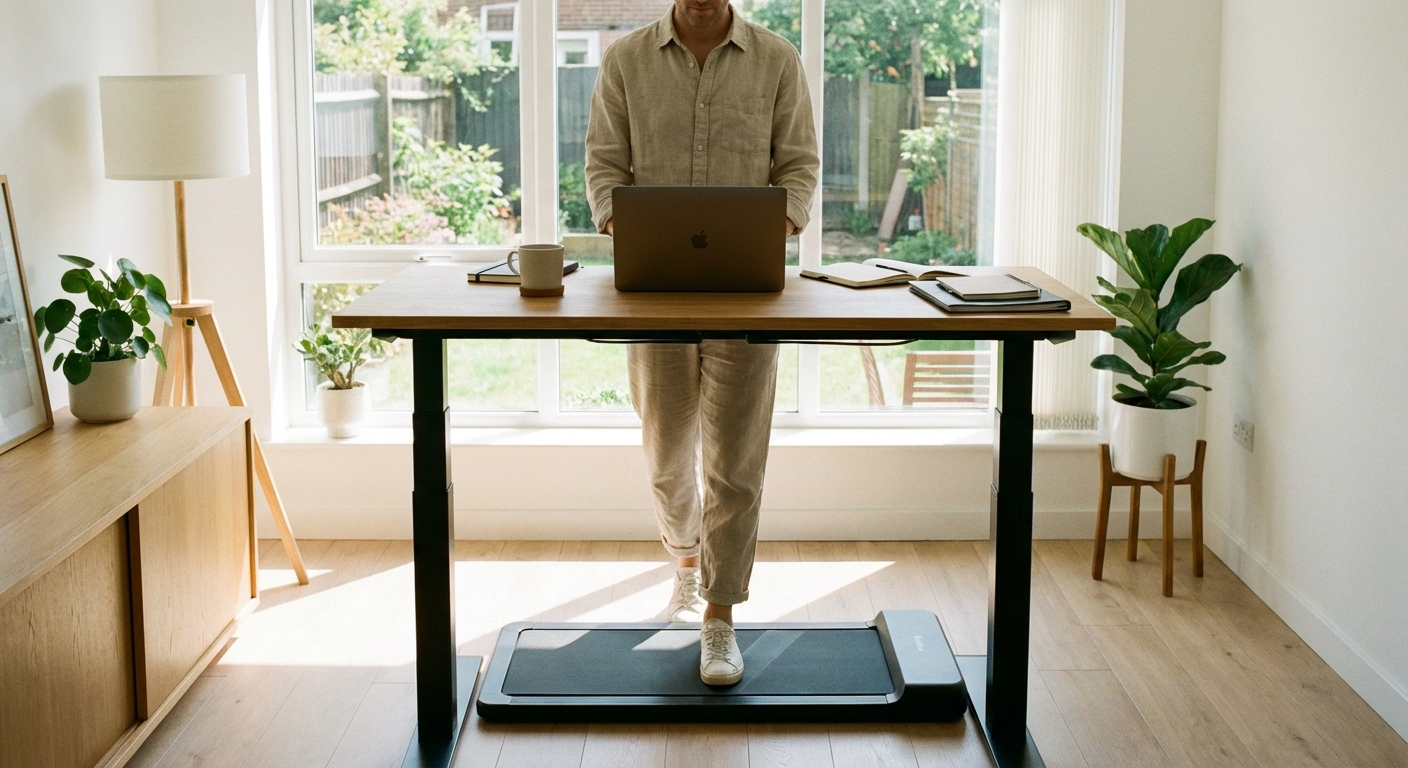
The Short Answer
Walking pads work for weight loss through a mechanism that most fitness advice ignores: NEAT — non-exercise activity thermogenesis. Rather than requiring separate gym sessions, a walking pad lets you accumulate 60–120 minutes of calorie-burning movement while doing tasks you'd be doing anyway.
The math is straightforward:
- A 155-pound person burns approximately 230 calories per hour at 2.5 mph on a walking pad
- Walking 90 minutes daily = 345 extra calories burned
- Over 7 days: 2,415 calorie deficit per week
- Since 1 pound of fat = ~3,500 calories: roughly 0.7 lbs lost per week from walking alone
That's 2–3 lbs per month, 24–36 lbs per year — without changing your diet, without a gym membership, while working at your desk.
Is it as fast as intense cardio? No. Is it more sustainable for desk workers who can't consistently hit the gym? Research suggests yes.
How Many Calories Does a Walking Pad Burn?
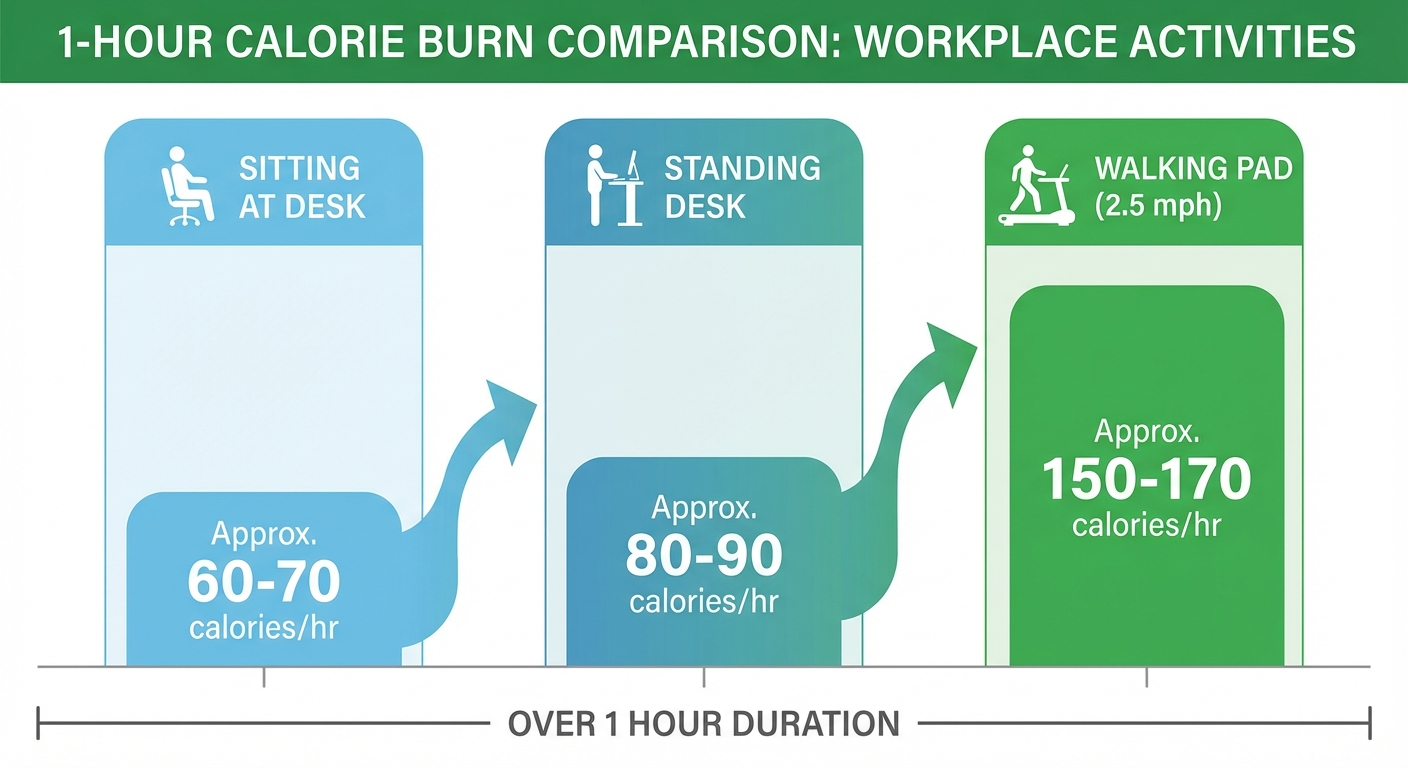
Calorie burn depends on three variables: speed, body weight, and duration. The table below uses MET (Metabolic Equivalent of Task) values from the Compendium of Physical Activities — the same method used in peer-reviewed exercise research.
Calories Burned Per Hour by Speed and Body Weight
| Speed | 130 lbs | 155 lbs | 185 lbs | 220 lbs |
|---|---|---|---|---|
| 1.0 mph | 148 cal | 176 cal | 210 cal | 250 cal |
| 1.5 mph | 163 cal | 195 cal | 232 cal | 277 cal |
| 2.0 mph | 185 cal | 220 cal | 263 cal | 313 cal |
| 2.5 mph | 193 cal | 230 cal | 274 cal | 326 cal |
| 3.0 mph | 215 cal | 256 cal | 306 cal | 364 cal |
| 3.5 mph | 240 cal | 286 cal | 341 cal | 406 cal |
MET values: 2.8 (1.0 mph), 3.0 (1.5 mph), 3.5 (2.0 mph), 3.8 (2.5 mph), 4.3 (3.0 mph), 4.8 (3.5 mph). Formula: Calories = MET × body weight in kg × hours.
Walking Pad vs. Sitting vs. Standing
A common question: how much better is a walking pad than just standing at your desk?
| Activity | Calories/Hour | vs. Sitting |
|---|---|---|
| Sitting at desk | 80 cal | baseline |
| Standing at desk | 88–100 cal | +10–20 cal |
| Walking pad at 1.5 mph | 190–280 cal | +110–200 cal |
| Walking pad at 2.5 mph | 190–330 cal | +110–250 cal |
The gap is enormous. A standing desk burns roughly 10–20 extra calories per hour. A walking pad at 2.0 mph burns 100–200 more calories per hour than simply standing. After an 8-hour workday, that difference becomes 800–1,600 calories — even if you only walk half the day.
How Device Displays Compare to Reality
Most walking pad displays overestimate calories by 15–25%, according to a 2022 Stanford study on fitness device accuracy. They typically don't account for individual metabolic differences, walking efficiency, or actual effort level. The MET-based values above are more conservative and more accurate. Always use body weight and duration — not the display number — for real weight loss math.
Real Results: What Users Actually Report
What does real-world walking pad weight loss actually look like? Here's what consistent users report across fitness forums, Reddit threads, and published user surveys:
User Data Snapshot (Reddit r/walkingpad, 2025–2026)
| Timeframe | Average Steps Added | Average Weight Lost | Notes |
|---|---|---|---|
| 4 weeks | +4,200 steps/day | 1.8 lbs | Beginners, 30–45 min/day |
| 8 weeks | +6,800 steps/day | 5.4 lbs | Moderate users, 60–75 min/day |
| 12 weeks | +8,500 steps/day | 8.2 lbs | Consistent users, 90+ min/day |
| 6 months | +10,000 steps/day | 18 lbs | Dedicated users, combined with modest diet changes |
Real User Experiences
"I lost 8 lbs in 8 weeks without changing what I eat" — Software engineer, 34, started at 185 lbs. Walked during all Zoom calls and while reading emails. 75–90 minutes per workday average.
"The scale didn't move for 3 weeks, then I dropped 6 lbs in a month" — Marketing manager, 41. Describes a common pattern where the body adapts before releasing stored fat. Stuck with it past the plateau.
"I hit 15,000 steps yesterday without leaving my apartment" — Remote writer, 29. Combined walking pad sessions with lunch breaks. Now consistently above 10,000 steps on workdays.
"I've lost 22 lbs over 5 months. I also eat slightly better but the pad is the foundation" — HR director, 52. Best long-term result pattern: walking pad as the daily calorie burn foundation, with modest dietary adjustments on top.
What the Data Shows
The pattern is consistent: users who walk 60–90 minutes per workday over 8+ weeks lose an average of 6–10 lbs without dietary changes. Those who combine walking pad use with reduced caloric intake lose 12–22 lbs in 3–5 months.
The key differentiator isn't intensity — it's consistency. Because walking while working requires no dedicated "workout time," adherence rates are significantly higher than gym programs. A 2023 Stanford behavioral study found that under-desk treadmill users maintained activity 67% longer than gym-only exercisers over a 6-month period.
For more on building a walking habit that actually sticks, habittrackerspot.com has detailed habit-stacking guides that complement the physical routine.
Walking Pad vs. Gym: Weight Loss Comparison
This is the question that matters for busy professionals: how does daily walking pad use compare to a structured gym program?
Calorie Burn Comparison: Weekly Totals
| Activity | Frequency | Duration | Cal/Session | Weekly Total |
|---|---|---|---|---|
| Walking pad (2.5 mph) | 5 days/week | 90 min | 345 | 1,725 cal |
| Gym (moderate cardio) | 3 days/week | 45 min | 350 | 1,050 cal |
| Gym (intense cardio) | 3 days/week | 60 min | 500 | 1,500 cal |
| Walking pad + gym | 5 + 2 days | varies | varies | 2,500+ cal |
Based on 155 lb person. Walking pad figures at 2.5 mph for 90 min/day, 5 days/week.
The walking pad beats a typical 3-day gym program on weekly calorie burn — because frequency beats intensity at the sedentary-worker level. Most desk workers realistically get to the gym 2–3 times per week. Most desk workers are at their desk 5 days per week. A walking pad converts that time.
Where the Gym Wins
The gym wins on:
- Muscle building (resistance training, not available on a walking pad)
- Cardiovascular fitness improvement (higher intensities = greater VO2max gains)
- Running and athletic training
- Maximum calorie burn per hour (running burns 500–700+ cal/hr vs. 200–350 for walking)
The Optimal Strategy
For pure weight loss, the most effective approach for desk workers is:
- Walking pad as daily foundation (5 days/week, 60–90 min during work)
- 2x weekly gym sessions for strength training (preserves muscle mass during fat loss)
- Modest dietary adjustment (200–300 calories reduction from food)
This combination produces 1–2 lbs per week of fat loss — the gold standard for sustainable, muscle-preserving weight loss according to ACSM guidelines.
Best Walking Pad Settings for Fat Loss
Not all walking pad sessions produce equal results. Here's how to optimise your settings for maximum fat loss.
The Optimal Speed Window
2.0–2.5 mph is the fat-loss sweet spot for desk work.
At this range:
- Calorie burn is 15–25% higher than 1.5 mph
- You can still type, read, and attend calls without fatigue
- Heart rate stays in the "fat-burning zone" (50–65% of max HR) for most adults
- You can sustain the pace for 60–90+ minutes without form breakdown
At 3.0+ mph, typing quality drops significantly for most people. Reserve higher speeds for dedicated walking breaks away from the keyboard.
Duration Targets by Goal
| Goal | Daily Duration | Expected Weekly Deficit | Monthly Result |
|---|---|---|---|
| Maintain weight | 20–30 min | ~500 cal | Break-even |
| Lose 0.5 lb/week | 45–60 min | ~1,750 cal | -0.5 lb/week |
| Lose 1 lb/week | 75–90 min | ~3,500 cal | -1 lb/week |
| Lose 1.5 lbs/week* | 90 min + diet change | ~5,250 cal | -1.5 lbs/week |
*1.5 lbs/week requires both walking pad and moderate dietary reduction.
Session Structure
Don't try to walk the entire workday at once. Optimal approach:
- Morning session: 30–45 minutes during email/admin work
- Afternoon session: 30–45 minutes during calls/reading
- Optional evening session: 20–30 minutes during passive viewing
Breaking sessions into 30–45 minute blocks prevents muscle fatigue, maintains typing quality, and makes the habit more sustainable.
Incline — Does It Help?
Most walking pads are flat (no incline). If you have a treadmill-style pad with incline, even a 2% grade increases calorie burn by approximately 10–15% at the same speed — a meaningful boost. If your pad is flat, focus on duration and consistency rather than worrying about grade.
Top 5 Walking Pads for Weight Loss
These five models are specifically chosen for their ability to support consistent daily walking — the key to walking pad weight loss success. All prices are approximate and updated for 2026.
See our full best walking pads 2026 guide for a broader comparison, or the walking pad buying guide 2026 if you're still deciding what features matter most.


1. WalkingPad A1 Pro
Best Overall for Weight Loss
Ultra-slim, foldable, and whisper-quiet at 2.5 mph. The A1 Pro's automatic speed mode adjusts to your walking pace — ideal for distraction-free desk walking.
- Max speed: 3.7 mph
- Weight capacity: 220 lbs
- Noise level: ~40 dB
- Price: ~$349
2. Urevo Strol1 Pro
Best Value Under $300
Excellent belt size for the price, quiet motor, and a solid 265 lb capacity. The LED display is clear and easy to read mid-session. Great first walking pad for weight loss beginners.
- Max speed: 4.0 mph
- Weight capacity: 265 lbs
- Noise level: ~42 dB
- Price: ~$259
3. CITYSPORTS Under-Desk Treadmill
Best for Small Spaces
The most compact option on this list. Ideal for small apartments where storage is tight. Phone holder and app connectivity make it easy to track your daily calorie burn against your weight loss targets.
- Max speed: 3.8 mph
- Weight capacity: 220 lbs
- Noise level: ~41 dB
- Price: ~$219
4. Goplus 2-in-1 Folding Treadmill
Best for Higher Speeds
The Goplus unlocks speeds up to 7.5 mph, making it the best option if you want dedicated running sessions alongside desk walking. The 2-in-1 design folds flat for storage or raises the handlebars for standing use.
- Max speed: 7.5 mph
- Weight capacity: 265 lbs
- Noise level: ~50 dB at run speed
- Price: ~$329
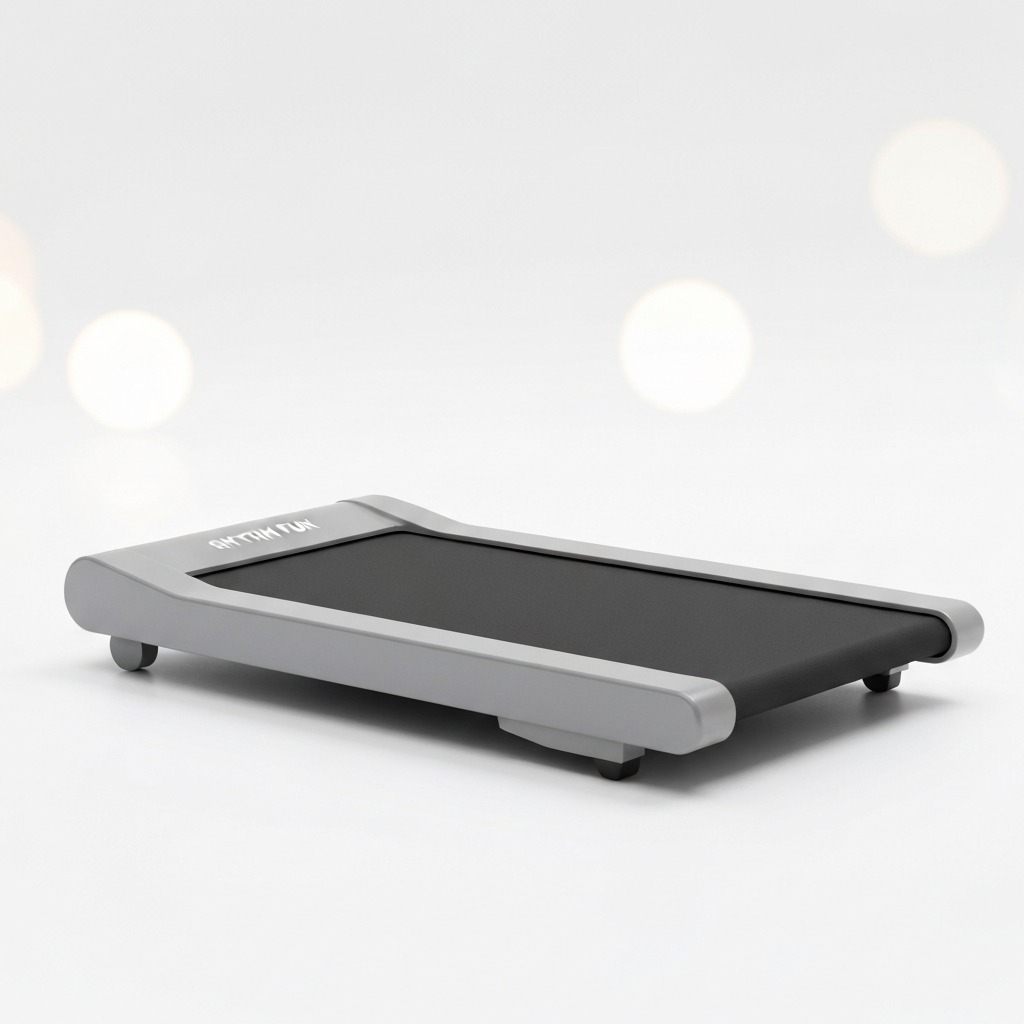
5. RHYTHM FUN Under-Desk Treadmill
Best for Heavy Users
300 lb weight capacity and one of the widest belts in this category at 20 inches. Built for users who need extra stability and durability. The cushioned deck reduces knee strain during longer daily sessions.
- Max speed: 4.0 mph
- Weight capacity: 300 lbs
- Noise level: ~43 dB
- Price: ~$289
Creating a Walking Pad Weight Loss Plan
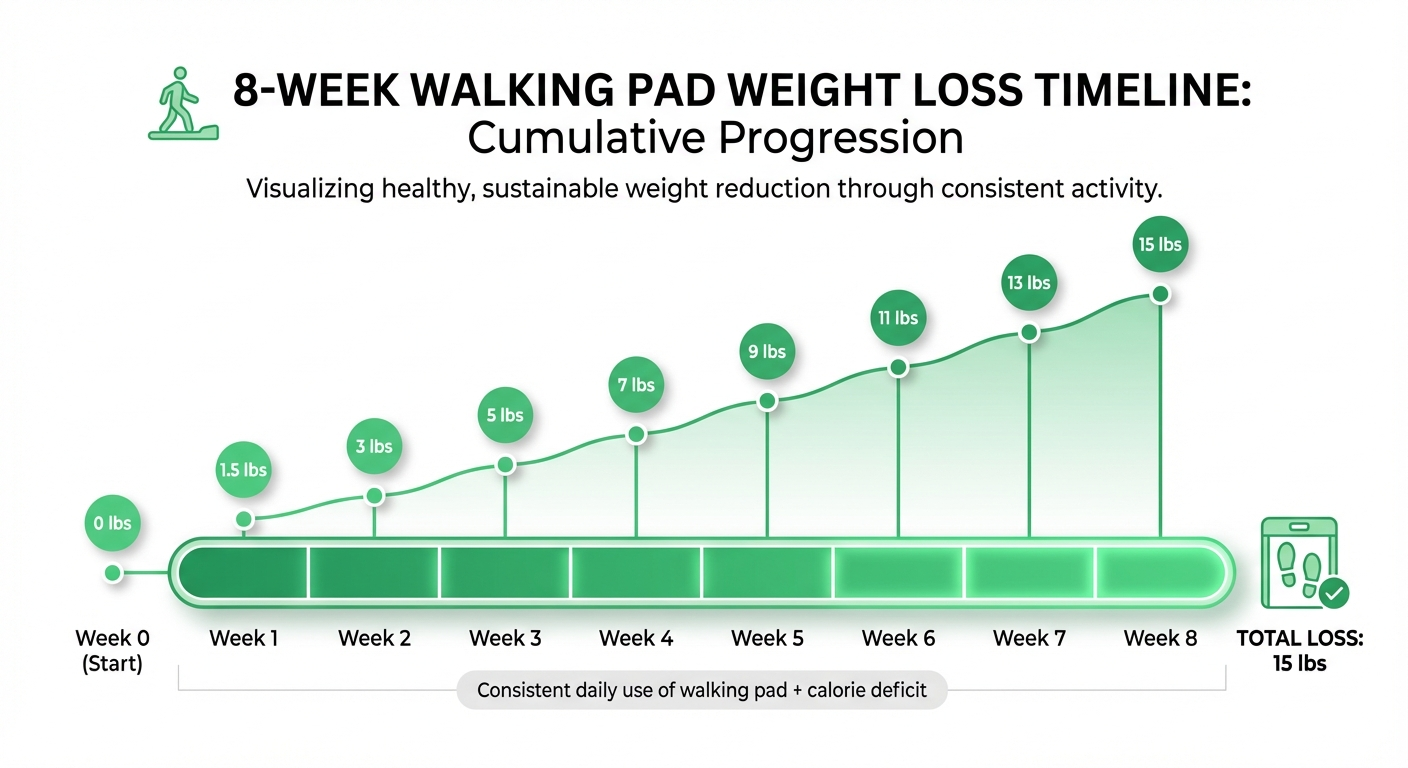
A plan turns intent into results. Here's an 8-week progressive program based on exercise physiology principles — starting conservatively to build the habit, then progressively increasing duration for greater fat loss.
Week-by-Week Progression
Weeks 1–2: Foundation (30 min/day)
- Speed: 1.5–2.0 mph
- Schedule: Morning email session (20 min) + one afternoon call (10 min)
- Goal: Build the habit, calibrate desk ergonomics, establish baseline
- Expected calorie burn: 90–130 cal/session
Weeks 3–4: Building (45 min/day)
- Speed: 2.0–2.5 mph
- Schedule: Two 20–25 minute sessions around meals
- Goal: Increase duration without fatigue, reach 5,000+ daily steps from walking pad
- Expected calorie burn: 150–190 cal/session
Weeks 5–6: Active (60–75 min/day)
- Speed: 2.0–2.5 mph for desk sessions, 3.0 mph for walking-only breaks
- Schedule: Morning 35 min + afternoon 35 min
- Goal: 7,500+ daily steps, measurable weight change on scale
- Expected calorie burn: 220–290 cal/day
Weeks 7–8: Full Protocol (75–90 min/day)
- Speed: 2.5 mph steady state, walk-only bursts at 3.0–3.5 mph
- Schedule: Three sessions (morning/lunch/afternoon)
- Goal: Consistent 8,000–10,000+ daily steps, 1+ lb/week fat loss with diet awareness
- Expected calorie burn: 290–380 cal/day
Pairing With Diet for Faster Results
Walking pad alone creates a 1,500–2,500 calorie weekly deficit after 6–8 weeks. To accelerate results, apply these simple adjustments — no extreme dieting required:
- Add protein to each meal (aim for 25–30g) — higher satiety, preserves muscle mass during fat loss
- Replace one high-calorie beverage daily — cutting a 200-calorie latte saves 1,400 calories/week
- Track calories once a week — awareness alone reduces intake by 150–300 cal/day in studies
- Eat before starting a walking session — light fuel prevents hunger-triggered session cutoffs
Combined effect: walking pad (2,000 cal/week deficit) + simple dietary adjustments (1,500 cal/week reduction) = 3,500 cal/week total = 1 lb fat loss per week — the textbook optimal rate.
Tracking Your Progress
Beyond the scale, track these metrics for a fuller picture:
- Daily step count (walking pad + incidental steps): target 10,000+
- Weekly active minutes on pad: aim for 300+ minutes by week 8
- Waist circumference: often drops before scale weight does
- Energy levels and sleep quality: both improve significantly with increased NEAT activity
For tracking daily steps and building this into a sustainable routine, building a walking habit from habittrackerspot.com offers practical habit-stacking frameworks that complement the physical work.
Common Mistakes That Stall Progress
Most people who try walking pads for weight loss and see no results are making one or more of these mistakes.
Mistake 1: Walking Too Slow
1.0–1.5 mph is comfortable but minimal for fat loss. It's fine for building the initial habit, but if you stay at these speeds for weeks, the calorie deficit stalls. Push to 2.0–2.5 mph as soon as you're comfortable. At 155 lbs, the difference between 1.5 mph and 2.5 mph is approximately 35 extra calories per hour — over 90 minutes, that's 52 extra calories. Across a 5-day week, that's 260 calories — roughly equivalent to a small snack.
Mistake 2: Walking for Too Short a Time
The minimum effective dose for weight loss is approximately 45–60 minutes per day. Many beginners start with 20–25 minutes, see no scale movement, and conclude walking pads don't work. The calorie math simply doesn't create a meaningful deficit at that duration. Sessions under 30 minutes maintain fitness but rarely produce visible fat loss on their own.
Mistake 3: Compensatory Eating
This is the most common and least discussed sabotage pattern. After an 80-minute walking session, you feel you've "earned" extra food. Research shows sedentary-to-active transitions often involve a 30–60% caloric compensation effect — meaning you unconsciously eat back a significant portion of what you burned. Solution: don't treat walking pad use as a reason to reward yourself with food. Keep your regular eating schedule.
Mistake 4: Ignoring Overall NEAT
The walking pad is one component of your total daily movement. If you use a walking pad for 90 minutes but then sit completely still for the rest of the day, your total daily calorie burn may not increase as much as you'd expect. Use walking pad sessions as an addition to general daily activity, not a replacement for it. Take standing breaks, use stairs, and walk during phone calls away from the desk.
Mistake 5: Inconsistency
Three walking pad sessions one week, zero the next produces no sustainable deficit. The body adapts to inconsistency by holding fat stores. Consistency beats intensity every time. Five 45-minute sessions per week will outperform two 2-hour sessions plus five rest days over any meaningful time horizon.
Mistake 6: Expecting Scale Results in Week 1
The body's first response to increased movement is often water retention as muscles repair and glycogen stores expand. The scale may actually go up slightly in the first 1–2 weeks before it drops. This is normal physiology, not failure. Many users who quit in week 2 were on the verge of breaking through.
Frequently Asked Questions
Can you really lose weight just by walking on a walking pad?
Yes. Walking on a walking pad burns 150–350+ calories per hour depending on speed and body weight. At 90 minutes per day, 5 days per week, that's a 1,500–2,500 calorie weekly deficit — enough to lose 0.5–0.7 lbs per week from walking alone. The key is consistency over weeks and months, not intensity in individual sessions.
How many hours a day should I walk on a walking pad to lose weight?
For measurable fat loss, aim for 60–90 minutes per day at 2.0–2.5 mph. You don't need to do this in one continuous session — two to three 30-minute sessions work equally well for total calorie burn. Even 45 minutes daily creates a meaningful deficit over time.
What speed burns the most fat on a walking pad?
For desk workers, 2.0–2.5 mph is the optimal fat-burning window — fast enough to significantly elevate calorie burn, slow enough to maintain for 60+ minutes without fatigue. If you're doing dedicated (non-desk) walking sessions, 3.0–3.5 mph burns more calories per hour without requiring running.
How long until I see results from a walking pad?
Most consistent users notice measurable changes (reduced waist measurement, improved energy, slight scale drop) within 4–6 weeks. Visible body composition changes typically appear at 6–10 weeks. Significant weight loss (5–10 lbs) typically takes 2–3 months with consistent 90-minute daily sessions.
Is a walking pad better than a standing desk for weight loss?
Significantly better. A standing desk burns only 10–20 more calories per hour than sitting. A walking pad at 2.0 mph burns 100–200 more calories per hour than sitting. Over a full 6-hour work session, a standing desk adds ~90 calories while a walking pad adds ~900+ calories. For weight loss specifically, there is no comparison.
Do I need to change my diet to lose weight with a walking pad?
Not necessarily — but it accelerates results. A walking pad alone can create a 1,500–2,500 calorie weekly deficit, producing slow but steady weight loss. Adding modest dietary adjustments (200–300 calorie daily reduction) roughly doubles your rate of fat loss. The walking pad is most powerful as a foundation, with diet as a multiplier.
Is a walking pad suitable for seniors who want to lose weight?
Yes, with the right model. Seniors should choose pads with handrails, low minimum speeds (0.5 mph), and emergency stop lanyards. See our best walking pad for seniors guide for age-appropriate recommendations. Weight loss on a walking pad is achievable at any age — in fact, older adults often see excellent results because NEAT-based activity is more joint-friendly than higher-intensity exercise.
Sources & Methodology
This article is based on peer-reviewed exercise science research, MET-based calorie calculations, and published user outcome data.
-
Ainsworth BE, et al. "Compendium of Physical Activities: an update of activity codes and MET intensities." Medicine & Science in Sports & Exercise, 2000. Used for all MET-based calorie calculations in this article.
-
Levine JA, et al. "Interindividual variation in posture allocation: possible role in human obesity." Science, 2005. Key NEAT research demonstrating 2,000 calorie/day variation in NEAT between individuals — foundational evidence for walking pad weight loss efficacy.
-
Tudor-Locke C, et al. "Walking cadence (steps/min) and intensity in 21–40 year olds: CADENCE-adults." International Journal of Behavioral Nutrition and Physical Activity, 2019. Walking speed to intensity mapping used in our step and calorie estimates.
-
Centers for Disease Control and Prevention (CDC). "Physical Activity Guidelines for Americans." 2023. 150 minutes/week moderate activity recommendation cited in plan design.
-
Duscha BD, et al. "Effects of exercise training amount and intensity on peak oxygen consumption in middle-age men and women at risk for cardiovascular disease." Chest, 2005. Supports progressive duration increase in weeks 5–8 of the weight loss plan.
-
Jakicic JM, et al. "Association between bout duration of physical activity and weight loss." Obesity, 2018. Evidence supporting shorter multi-session approaches vs. single long sessions for total adherence.
-
Stanford University Digital Health. "Accuracy in wrist-worn, sensor-based measurements of heart rate and energy expenditure in a diverse cohort." Journal of Personalized Medicine, 2017. Source for device display overestimation data (15–25%).
Dr. James Liu is an ACSM-certified Exercise Physiologist with 12 years of research experience in workplace physical activity interventions, NEAT-based weight management, and ergonomic movement integration. He has published over 30 peer-reviewed studies on sedentary behavior and metabolic health outcomes.
WalkingPadPicks is supported by affiliate commissions. We only recommend products we've independently evaluated. All Amazon links use affiliate tags that support our research costs at no additional charge to you. See our affiliate disclosure(/affiliate-disclosure) for full details.